Advertisements
Advertisements
प्रश्न
In the above given problem if the lower thread is pulled with a jerk, what happens?
Advertisements
उत्तर
If thread CD is pulled with a jerk then it will break from point C because the force acting at point C is not moving further to point A due to the inertia of the rest of the suspended mass of 2 kg.
APPEARS IN
संबंधित प्रश्न
What is the other name of Newton’s first law of motion ?
Find the acceleration produced by a force of 5 N acting on a mass of 10 kg.
It is sometimes heard that the inertial frame of reference is only an ideal concept and no such inertial frame actually exists. Comment.
The figure shows a light spring balance connected to two blocks of mass 20 kg each. The graduations in the balance measure the tension in the spring. (a) What is the reading of the balance? (b) Will the reading change if the balance is heavy, say 2.0 kg? (c) What will happen if the spring is light but the blocks have unequal masses?
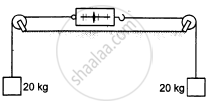
The acceleration of a particle is zero, as measured from an inertial frame of reference. Can we conclude that no force acts on the particle?
In an imaginary atmosphere, the air exerts a small force F on any particle in the direction of the particle's motion. A particle of mass m projected upward takes time t1 in reaching the maximum height and t2 in the return journey to the original point. Then.
If you jump barefoot on a hard surface, your legs are injured. But they are not injured if you jump on a soft surface like sand or pillow. Why?
State Newton's first law of motion.
A force of 600 dynes acts on a glass ball of mass 200 g for 12 s. If initially, the ball is at rest, find
- Final velocity
- Distance covered.
Derive the relation between newton and dyne.
A man riding on a car has ___________ Inertia.
Give two examples of the following:
Inertia of rest
Give two examples of the following:
Inertia of motion
Name the scientist who first stated the law of inertia.
This question has Statement 1 and Statement 2. Of the four choices given after the Statements, choose the one that best describes the two Statements.
Statement 1: If you push on a cart being pulled by a horse so that it does not move, the cart pushes you back with an equal and opposite force.
Statement 2: The cart does not move because the force described in statement 1 cancel each other.
What does inertia measure in an object?
