Advertisements
Advertisements
प्रश्न
Derive the relation between newton and dyne.
Advertisements
उत्तर
Relation between newton and dyne:
1 N = 1 kg × ms−2 = 1000 g × 100 cm s−2
1 N = 100000 g cm s−2
1 N = 105 g cm s−2
1 N = 105 ............[∴ 1 dyne = 1 g cm s−2]
APPEARS IN
संबंधित प्रश्न
Give the magnitude and direction of the net force acting on a drop of rain falling down with a constant speed.
It is sometimes heard that the inertial frame of reference is only an ideal concept and no such inertial frame actually exists. Comment.
A block of 2 kg is suspended from a ceiling by a massless spring of spring constant k = 100 N/m. What is the elongation of the spring? If another 1 kg is added to the block, what would be the further elongation?
How does Newton's second law of motion differ from the first law of motion?
A man riding on a car has ___________ Inertia.
Give two examples of the following:
Inertia of rest
When a bus suddenly takes a tum, the passengers are thrown outwards because of
A body of mass 10 kg is acted upon by two perpendicular forces, 6 N and 8 N. The resultant acceleration of the body is ______.
- 1 m s–2 at an angle of tan−1 `(4/3)` w.r.t 6 N force.
- 0.2 m s–2 at an angle of tan−1 `(4/3)` w.r.t 6 N force.
- 1 m s–2 at an angle of tan−1 `(3/4)` w.r.t 8 N force.
- 0.2 m s–2 at an angle of tan−1 `(3/4)` w.r.t 8 N force.
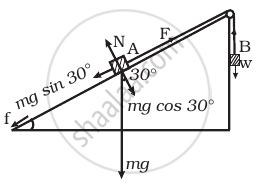
Block A of weight 100 N rests on a frictionless inclined plane of slope angle 30° (figure). A flexible cord attached to A passes over a frictonless pulley and is connected to block B of weight W. Find the weight W for which the system is in equilibrium.
When does an object accelerate?
