Advertisements
Advertisements
प्रश्न
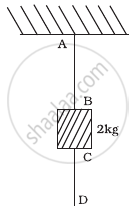
A mass of 2 kg is suspended with thread AB (Figure). Thread CD of the same type is attached to the other end of 2 kg mass. Lower thread is pulled gradually, harder and harder in the downward directon so as to apply force on AB. Which of the threads will break and why?
Advertisements
उत्तर
The thread AB will break earlier than the thread CD. This is because forces acting on thread CD = applied force and force acting on thread AB = (applied force + weight of 2 kg mass). Hence, the force acting on thread AB is larger than the force acting on thread CD.
APPEARS IN
संबंधित प्रश्न
What is the other name of Newton’s first law of motion ?
Name the scientist who gave the laws of motion.
Define one newton force.
Is it possible for a particle to describe a curved path if no force acts on it? Does your answer depend on the frame of reference chosen to view the particle?
A reference frame attached to the earth
(a) is an inertial frame by definition
(b) cannot be an inertial frame because the earth is revolving around the sun
(c) is an inertial frame because Newton's laws are applicable in this frame
(d) cannot be an inertial frame because the earth is rotating about its axis.
A block of mass 2 kg placed on a long frictionless horizontal table is pulled horizontally by a constant force F. It is found to move 10 m in the first seconds. Find the magnitude of F.
'When a hanging carpet is beaten with a stick, the dust particles start coming out of it'. This phenomenon can be best explained by making use of :
State Newton's first law of motion.
A force of 600 dynes acts on a glass ball of mass 200 g for 12 s. If initially, the ball is at rest, find
- Final velocity
- Distance covered.
Give one example each of inertia of rest and inertia of motion.
The amount of inertia of a body depends on its _________.
Classify the types of force based on their application.
When a bus suddenly takes a tum, the passengers are thrown outwards because of
Newton's first law of motion describes ______.
In the above given problem if the lower thread is pulled with a jerk, what happens?
Two blocks A and B of masses m and 2 m, respectively, are held at rest such that the spring is in natural length. Find out the accelerations of both the blocks just after release.

Match the following.
| Column I | Column II |
| a. Newton’s I law | propulsion of a rocket |
| b. Newton’s II law | Stable equilibrium of the body |
| c. Newton’s III law | Law of force |
| d. Law of conservation of Linear momentum | Flying nature of bird |
What is the significance of Newton’s first law?
How is force defined according to Newton’s First Law?
