Advertisements
Advertisements
प्रश्न
In a TV picture tube, electrons are ejected from the cathode with negligible speed and they attain a velocity of 5 × 10⁶ m/s in travelling one centimetre. Assuming straight-line motion, find the constant force exerted on the electrons. The mass of an electron is 9.1 × 10⁻³¹ kg.
Advertisements
उत्तर
Initial velocity of the electrons is negligible, i.e. u = 0.
Final velocity of the electrons, v = 5 × 10⁶ m/s
Distance travelled by the electrons,
s = 1 cm = 1 × 10⁻² m
∴ Acceleration, \[a = \frac{v^2 - u^2}{2 S}\]
\[\Rightarrow a = \frac{\left( 5 \times {10}^5 \right)^2 - 0}{2 \times 1 \times {10}^{- 3}} = \frac{25 \times {10}^{12}}{2 \times {10}^{- 2}}\]
So, force on the electrons, F = ma
⇒ F = 9.1 × 10−31 × 12.5 × 10−14
= 1.1 × 10⁻¹⁵ N
APPEARS IN
संबंधित प्रश्न
A constant retarding force of 50 N is applied to a body of mass 20 kg moving initially with a speed of 15 ms–1. How long does the body take to stop?
A body of mass 0.40 kg moving initially with a constant speed of 10 m s–1 to the north is subject to a constant force of 8.0 N directed towards the south for 30 s. Take the instant the force is applied to be t = 0, the position of the body at that time to be x = 0, and predict its position at t = –5 s, 25 s, 100 s.
A stone of mass m tied to the end of a string revolves in a vertical circle of radius R. The net forces at the lowest and highest points of the circle directed vertically downwards are: [Choose the correct alternative]
| Lowest Point | Highest Point | |
| a) | mg – T1 | mg + T2 |
| b) | mg + T1 | mg – T2 |
| c) | `mg + T1 –(m_v_1^2)/R` | mg – T2 + (`mv_1^2`)/R |
| d) | `mg – T1 – (mv)/R` | mg + T2 + (mv_1^2)/R |
T1 and v1 denote the tension and speed at the lowest point. T2 and v2 denote corresponding values at the highest point.
A spy jumps from an airplane with his parachute. The spy accelerates downward for some time when the parachute opens. The acceleration is suddenly checked and the spy slowly falls to the ground. Explain the action of the parachute in checking the acceleration.
car moving at 40 km/hr is to be stopped by applying brakes in the next 4 m. If the car weighs 2000 kg, what average force must be applied to stop it?
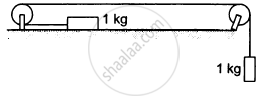
Calculate the tension in the string shown in the following figure. The pulley and the string are light and all the surfaces are frictionless. Take g = 10 m/s2.
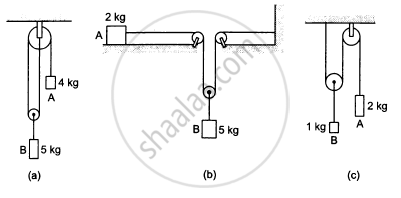
Find the acceleration of the blocks A and B in the three situations shown in the following figure.
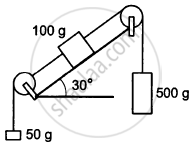
Find the acceleration of the 500 g block in the following figure.
State Newton's second law of motion. Under what condition does it take the form F = ma?
The correct form of Newton's second law is :
A stone is dropped freely from the top of a tower and it reaches the ground in 4 s. Taking g = 10m s-2, calculate the height of the tower.
A pebble is dropped freely in a well from its top. It takes 20 s for the pebble to reach the water surface in the well. Taking g = 10 m s-2 and speed of sound = 330 m s-1. Find : The time when echo is heard after the pebble is dropped.
Which of the following has the largest inertia?
A stone is dropped from a cliff 98 m high.
How long will it take to fall to the foot of the cliff?
A stone is thrown vertically upward with a velocity of 9.8 m/s. When will it reach the ground?
A stone is dropped from a tower 98 m high. With what speed should a second stone be thrown 1 s later so that both hit the ground at the same time?
A metre scale is moving with uniform velocity. This implies ______.
In the previous problem (5.3), the magnitude of the momentum transferred during the hit is ______.
Why does a child feel more pain when she falls down on a hard cement floor, than when she falls on the soft muddy ground in the garden?
