Advertisements
Advertisements
प्रश्न
A block of mass 0.2 kg is suspended from the ceiling by a light string. A second block of mass 0.3 kg is suspended from the first block by another string. Find the tensions in the two strings. Take g = 10 m/s2.
Advertisements
उत्तर
The free-body diagrams for both the blocks are shown below: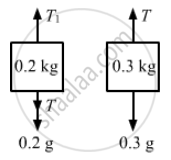 |
|
From the free-body diagram of the 0.3 kg block,
T = 0.3g
⇒ T= 0.3 × 10 = 3 N
Now, from the free-body diagram of the 0.2 kg block,
T1 = 0.2g + T
⇒ T1= 0.2 × 10 + 3 = 5 N
∴ The tensions in the two strings are 5 N and 3 N, respectively.
APPEARS IN
संबंधित प्रश्न
A batsman deflects a ball by an angle of 45° without changing its initial speed which is equal to 54 km/h. What is the impulse imparted to the ball? (Mass of the ball is 0.15 kg.)
Explain why a cricketer moves his hands backwards while holding a catch.
An empty plastic box of mass m is found to accelerate up at the rate of g/6 when placed deep inside water. How much sand should be put inside the box so that it may accelerate down at the rate of g/6?
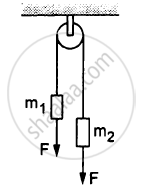
In the following figure, m1 = 5 kg, m2 = 2 kg and F = 1 N. Find the acceleration of either block. Describe the motion of m1 if the string breaks but F continues to act.
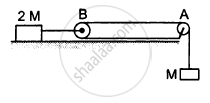
Consider the situation shown in the following figure. Both the pulleys and the string are light and all the surfaces are frictionless.
- Find the acceleration of the mass M.
- Find the tension in the string.
- Calculate the force exerted by the clamp on the pulley A in the figure.
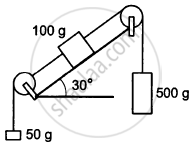
Find the acceleration of the 500 g block in the following figure.
How can Newton's first law of motion be obtained from the second law of motion?
A force of 10 N acts on a body of mass 2 kg for 3 s, initially at rest. Calculate : Change in momentum of the body.
A force acts for 10 s on a stationary body of mass 100 kg, after which the force ceases to act. The body moves through a distance of 100 m in the next 5 s. Calculate: The velocity acquired by the body.
A car is moving with a uniform velocity 30 ms-1. It is stopped in 2 s by applying a force of 1500 N through its brakes. Calculate the following values : The change in momentum of car.
What do you understand by the term momentum?
Prove mathematically F = ma
Multiple Choice Question. Select the correct option.
The impulse of a body is equal to:
ame the law of motion which gives the definition of force.
State Newton's second law of motion.
A body of mass 400 g is resting on a frictionless table. Find the acceleration of the body when acted upon by a force of 0.02 N.
Use Newton's second law to explain the following:
We always prefer to land on sand instead of hard floor while taking a high jump.
A ball is thrown upward and reaches a maximum height of 19.6 m. Find its initial speed?
A woman throws an object of mass 500 g with a speed of 25 ms1.
- What is the impulse imparted to the object?
- If the object hits a wall and rebounds with half the original speed, what is the change in momentum of the object?
According to Newton's Second Law of Motion, what quantity is directly proportional to the applied force?
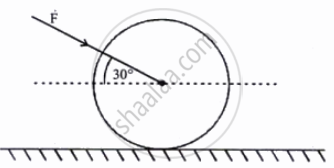
As shown in figure, a 70 kg garden roller is pushed with a force of F = 200 N at an angle of 30° with horizontal. The normal reaction on the roller is: (Given: g = 10 ms−2)