Advertisements
Advertisements
प्रश्न
A body of mass m moving with a velocity v is acted upon by a force. Write an expression for change in momentum in each of the following cases: (i) When v << c, (ii) When v → c and (iii) When v << c but m does not remain constant. Here, c is the speed of light.
Advertisements
उत्तर
(i) When v << c,
Δp = Δ(mv) = mΔv
(ii) When v → c,
Δp = Δ(mv)
(iii) When v<<c but m does not remain constant.
Δp = Δ(mv)
APPEARS IN
संबंधित प्रश्न
Suppose the ceiling in the previous problem is that of an elevator which is going up with an acceleration of 2.0 m/s2. Find the elongation.
An empty plastic box of mass m is found to accelerate up at the rate of g/6 when placed deep inside water. How much sand should be put inside the box so that it may accelerate down at the rate of g/6?
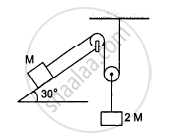
Find the acceleration of the block of mass M in the situation shown in the following figure. All the surfaces are frictionless and the pulleys and the string are light.
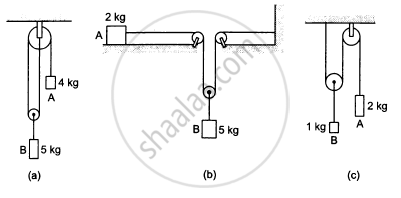
Find the acceleration of the blocks A and B in the three situations shown in the following figure.
Write the mathematical form of Newton's second law of motion. State the conditions if any.
Use Newton's second law of motion to explain the following instance :
A cricketer pulls his hands back while catching a fast moving cricket ball .
Define Newton’s second law of motion.
Prove mathematically F = ma
Name the physical entity used for quantifying the motion of a body.
State Newton's second law of motion.
A body of mass 400 g is resting on a frictionless table. Find the acceleration of the body when acted upon by a force of 0.02 N.
