Advertisements
Advertisements
Question
A body of mass m moving with a velocity v is acted upon by a force. Write an expression for change in momentum in each of the following cases: (i) When v << c, (ii) When v → c and (iii) When v << c but m does not remain constant. Here, c is the speed of light.
Advertisements
Solution
(i) When v << c,
Δp = Δ(mv) = mΔv
(ii) When v → c,
Δp = Δ(mv)
(iii) When v<<c but m does not remain constant.
Δp = Δ(mv)
APPEARS IN
RELATED QUESTIONS
A free 238U nucleus kept in a train emits an alpha particle. When the train is stationary, a nucleus decays and a passenger measures that the separation between the alpha particle and the recoiling nucleus becomes x at time t after the decay. If the decay takes place while the train is moving at a uniform velocity v, the distance between the alpha particle and the recoiling nucleus at a time t after the decay, as measured by the passenger, is
Define linear momentum and state its S.I. unit.
Two bodies A and B of same mass are moving with velocities v and 2v, respectively. Compare their (i) inertia and (ii) momentum.
A force acts for 10 s on a stationary body of mass 100 kg, after which the force ceases to act. The body moves through a distance of 100 m in the next 5 s. Calculate : The magnitude of the force
Multiple Choice Question. Select the correct option.
The impulse of a body is equal to:
Why is it advantageous to turn before taking a long jump?
A woman throws an object of mass 500 g with a speed of 25 ms1.
- What is the impulse imparted to the object?
- If the object hits a wall and rebounds with half the original speed, what is the change in momentum of the object?
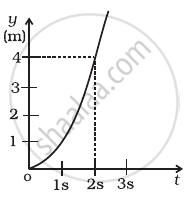
Figure shows (x, t), (y, t ) diagram of a particle moving in 2-dimensions.
|
|
 (b) |
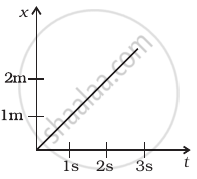
If the particle has a mass of 500 g, find the force (direction and magnitude) acting on the particle.
What happens when a car brakes to come to a stop?
How does moving your hand backward while catching a cricket ball reduce pain?
