Advertisements
Advertisements
प्रश्न
A force acts for 10 s on a stationary body of mass 100 kg, after which the force ceases to act. The body moves through a distance of 100 m in the next 5 s. Calculate: The velocity acquired by the body.
Advertisements
उत्तर
Mass, m = 100 kg
Distance moved, s = 100 m
Initial velocity, u = 0
Because the body moves through a distance of 100 m in 5 s,
Velocity of the body = `"Distance moved"/"time taken"`
Velocity = `100/5`
= 20 m/s
APPEARS IN
संबंधित प्रश्न
A helicopter of mass 1000 kg rises with a vertical acceleration of 15 m s–2. The crew and the passengers weigh 300 kg. Give the magnitude and direction of the
(a) force on the floor by the crew and passengers,
(b) action of the rotor of the helicopter on the surrounding air,
(c) force on the helicopter due to the surrounding air.
Suppose the ceiling in the previous problem is that of an elevator which is going up with an acceleration of 2.0 m/s2. Find the elongation.
Find the acceleration of the blocks A and B in the three situations shown in the following figure.
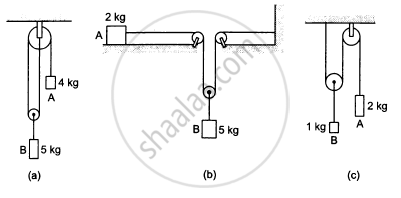
A car is moving with a uniform velocity 30 ms-1. It is stopped in 2 s by applying a force of 1500 N through its brakes. Calculate the following values : The change in momentum of car.
An electron of mass 9 × 10⁻³¹ kg is moving with a linear velocity of 6 × 10⁷ ms−1. Calculate the linear momentum of electron.
Multiple Choice Question. Select the correct option.
Which of the following are vector quantities?
Why is it advantageous to turn before taking a long jump?
Use Newton's second law to explain the following:
We always prefer to land on sand instead of hard floor while taking a high jump.
In the previous problem (5.3), the magnitude of the momentum transferred during the hit is ______.
A body of mass 2 kg travels according to the law x(t) = pt + qt2 + rt3 where p = 3 ms−1, q = 4 ms−2 and r = 5 ms−3. The force acting on the body at t = 2 seconds is ______.
