Advertisements
Advertisements
प्रश्न
A force acts for 10 s on a stationary body of mass 100 kg, after which the force ceases to act. The body moves through a distance of 100 m in the next 5 s. Calculate : The acceleration produced by the force
Advertisements
उत्तर
Mass, m = 100 kg
Distance moved, s = 100 m
Initial velocity, u = 0
From Newton's third equation of motion,
v2 - u2 = 2as.
Or, a = (v2 - u2) /2s.
Or, a = [ (202 - 02)/ 2(100) ] ms-2.
Or, a = 2 ms-2.
APPEARS IN
संबंधित प्रश्न
Which force is responsible for the moon revolving round the earth ?
Explain why, a wide steel belt is provided over the wheels of an army tank.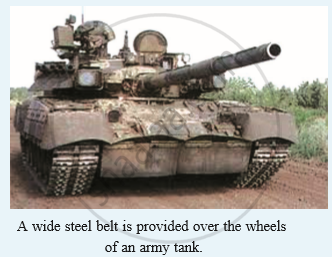
Explain why, the tip of a sewing needle is sharp.
Solve the problem.
If the mass of a planet is eight times the mass of the Earth and its radius is twice the radius of the Earth, what will be the escape velocity for that planet?
i) If g = GM/r2 then where will the value of g be high at Goa Beach or on top of Mount Everest?
A force acts for 0.1 s on a body of mass 2.0 kg initially at rest. The force is then withdrawn and the body moves with a velocity of 2 m s-1. Find the magnitude of the force.
Define the term acceleration due to gravity? Write its S.I. unit.
What force, in newton, your muscles need to apply to hold a mass of 5 kg in your hand? State the assumption.
Write scientific reasons.
When we drop a feather and a stone at the same time from a height the stone reach the earth faster than a feather.
When is free fall possible?
