Advertisements
Advertisements
प्रश्न
What causes motion in a body?
Advertisements
उत्तर
APPEARS IN
संबंधित प्रश्न
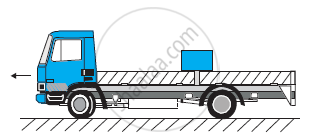
The rear side of a truck is open and a box of 40 kg mass is placed 5 m away from the open end as shown in Figure. The coefficient of friction between the box and the surface below it is 0.15. On a straight road, the truck starts from rest and accelerates with 2 m s–2. At what distance from the starting point does the box fall off the truck? (Ignore the size of the box).
You are travelling in a car. The driver suddenly applies the brakes and you are pushed forward. Why does this happen?
A man has fallen into a ditch of width d and two of his friends are slowly pulling him out using a light rope and two fixed pulleys as shown in the following figure. Show that the force (assumed equal for both the friends) exerted by each friend on the road increases as the man moves up. Find the force when the man is at a depth h.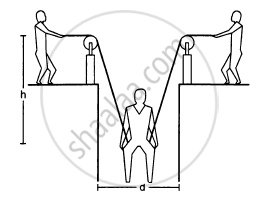
A tennis ball and a cricket ball , both are stationary. To start motion in them .
A force of 10 N acts on a body of mass 2 kg for 3 s, initially at rest. Calculate : Change in momentum of the body.
A force acts for 10 s on a stationary body of mass 100 kg, after which the force ceases to act. The body moves through a distance of 100 m in the next 5 s. Calculate : The magnitude of the force
State two factors which determine the momentum of a body.
What do you mean by linear momentum of a body?
In the previous problem (5.3), the magnitude of the momentum transferred during the hit is ______.
A body of mass 2 kg travels according to the law x(t) = pt + qt2 + rt3 where p = 3 ms−1, q = 4 ms−2 and r = 5 ms−3. The force acting on the body at t = 2 seconds is ______.
