Advertisements
Advertisements
प्रश्न
A block of mass m is placed on a smooth wedge of inclination θ. The whole system is accelerated horizontally so that the block does not slip on the wedge. The force exerted by the wedge on the block has a magnitude.
पर्याय
mg
mg/cosθ
mg cosθ
mg tanθ
Advertisements
उत्तर
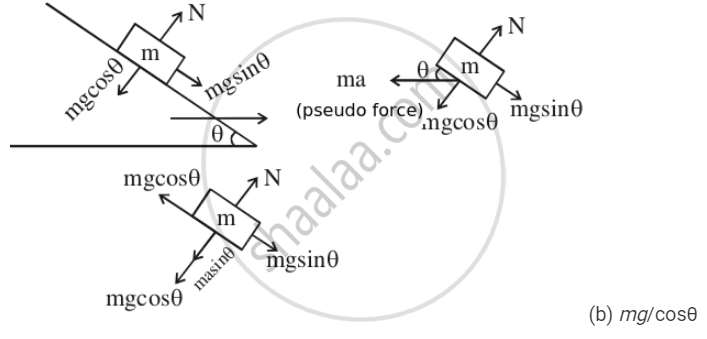
Free-body Diagram of the Small Block of Mass 'm'
The block is at equilibrium w.r.t. to wedge. Therefore,
mg sinθ = ma cosθ
⇒ a = gtanθ
Normal reaction on the block is
N = mg cosθ + ma sinθ
Putting the value of a, we get:
N = mg cosθ + mg tanθsinθ
\[N = mg\cos\theta + mg\frac{\sin\theta}{\cos\theta}\sin\ \theta N=\frac{mg}{\cos\theta}\]
APPEARS IN
संबंधित प्रश्न
An aircraft executes a horizontal loop at a speed of 720 km/h with its wings banked at 15°. What is the radius of the loop?
A smooth wedge A is fitted in a chamber hanging from a fixed ceiling near the earth's surface. A block B placed at the top of the wedge takes time T to slide down the length of the wedge. If the block is placed at the top of the wedge and the cable supporting the chamber is broken at the same instant, the block will.
A force \[\vec{F} = \vec{v} \times \vec{A}\] is exerted on a particle in addition to the force of gravity, where \[\vec{v}\] is the velocity of the particle and \[\vec{A}\] is a constant vector in the horizontal direction. With what minimum speed, a particle of mass m be projected so that it continues to move without being defelected and with a constant velocity?
Consider the situation shown in the following figure. Both the pulleys and the string are light and all the surfaces are frictionless.
- Find the acceleration of the mass M.
- Find the tension in the string.
- Calculate the force exerted by the clamp on the pulley A in the figure.
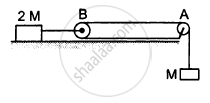
Find the acceleration of the block of mass M in the situation shown in the following figure. All the surfaces are frictionless and the pulleys and the string are light.
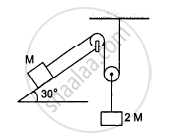
Find the mass M of the hanging block in the following figure that will prevent the smaller block from slipping over the triangular block. All the surfaces are frictionless and the strings and the pulleys are light.
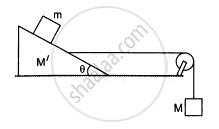
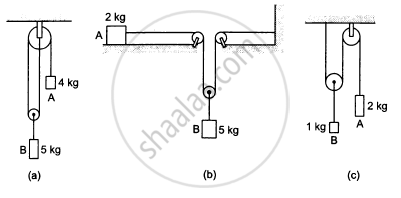
Find the acceleration of the blocks A and B in the three situations shown in the following figure.
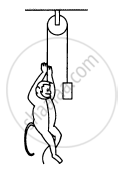
A monkey is climbing on a rope that goes over a smooth light pulley and supports a block of equal mass at the other end in the following figure. Show that whatever force the monkey exerts on the rope, the monkey and the block move in the same direction with equal acceleration. If initially both were at rest, their separation will not change as time passes.
A tennis ball and a cricket ball , both are stationary. To start motion in them .
Two balls A and B of masses m and 2 m are in motion with velocities 2v and v, respectively. Compare:
(i) Their inertia.
(ii) Their momentum.
(iii) The force needed to stop them in the same time.
A body of mass 5 kg is moving with velocity 2 m s-1. Calculate its linear momentum.
The linear momentum of a ball of mass 50 g is 0.5 kg m s-1. Find its velocity.
A pebble is thrown vertically upwards with a speed of 20 m s-1. How high will it be after 2 s? (Take g = 10 m s-2)
What do you understand by the term momentum?
Name the physical entity used for quantifying the motion of a body.
A stone is dropped from a cliff 98 m high.
What will be its speed when it strikes the ground?
What do you mean by the conservation of momentum? Briefly, explain the collision between two bodies and the conservation of momentum.
The motion of a particle of mass m is given by x = 0 for t < 0 s, x(t) = A sin 4 pt for 0 < t < (1/4) s (A > o), and x = 0 for t > (1/4) s. Which of the following statements is true?
- The force at t = (1/8) s on the particle is – 16π2 Am.
- The particle is acted upon by on impulse of magnitude 4π2 A m at t = 0 s and t = (1/4) s.
- The particle is not acted upon by any force.
- The particle is not acted upon by a constant force.
- There is no impulse acting on the particle.
Why is catching a slow-moving ball easier than catching a fast-moving ball?
