Advertisements
Advertisements
प्रश्न
What do you mean by linear momentum of a body? A force causes an acceleration of 10 ms-2 in a body of mass 1 kg. What acceleration will be caused by the same force in a body of mass 4 kg?
Advertisements
उत्तर
Linear Momentum is defined as the physical quantity which is associated with bodies in linear motion. It is given by the product of the mass of the body and its velocity.
Mass of body = 1 kg
Acceleration produced = 10 ms-2.
Force applied would be = 1 X 10 N = 10 N.
Mass of second body = 4 kg.
As same force has to be applied on second body so force = 10N.
Acceleration produced is = F/M =10/4 = 2.5 ms-2.
APPEARS IN
संबंधित प्रश्न
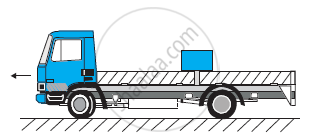
The rear side of a truck is open and a box of 40 kg mass is placed 5 m away from the open end as shown in Figure. The coefficient of friction between the box and the surface below it is 0.15. On a straight road, the truck starts from rest and accelerates with 2 m s–2. At what distance from the starting point does the box fall off the truck? (Ignore the size of the box).
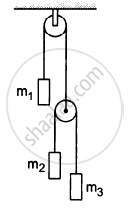
Let m1 = 1 kg, m2 = 2 kg and m3 = 3 kg in the following figure. Find the accelerations of m1, m2 and m3. The string from the upper pulley to m1 is 20 cm when the system is released from rest. How long will it take before m1 strikes the pulley?
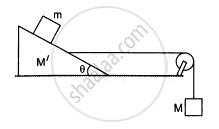
Find the mass M of the hanging block in the following figure that will prevent the smaller block from slipping over the triangular block. All the surfaces are frictionless and the strings and the pulleys are light.
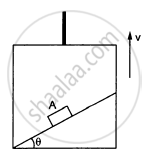
A block A can slide on a frictionless incline of angle θ and length l, kept inside an elevator going up with uniform velocity v in the following figure. Find the time taken by the block to slide down the length of the incline if it is released from the top of the incline.
A block is kept on the floor of an elevator at rest. The elevator starts descending with an acceleration of 12 m/s2. Find the displacement of the block during the first 0.2 s after the start. Take g = 10 m/s2.
Multiple Choice Question. Select the correct option.
A force acts on a body of mass 3 kg such that its velocity changes from 4 ms−1 to 10 ms−1. The change in momentum of the body is
Name the physical entity used for quantifying the motion of a body.
Which of the following has the largest inertia?
What do you mean by the conservation of momentum? Briefly, explain the collision between two bodies and the conservation of momentum.
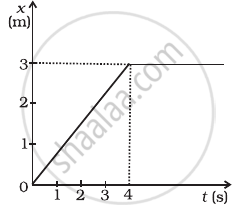
The position time graph of a body of mass 2 kg is as given in figure. What is the impulse on the body at t = 0 s and t = 4 s.