Advertisements
Advertisements
प्रश्न
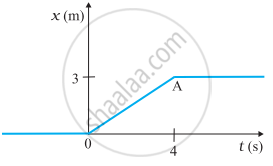
The below figure shows the position-time graph of a particle of mass 4 kg.
- What is the force on the particle for t < 0, t > 4 s, 0 < t < 4 s?
- What is the impulse at t = 0 and t = 4 s? (Consider one-dimensional motion only.)
Advertisements
उत्तर
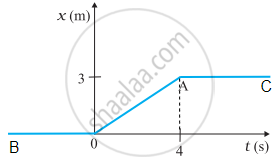
- For t < 0
For t<0, the graph of position versus time is denoted as BO, which indicates that the displacement of the particle is zero, i.e., the particle is stationary at the origin. Consequently, the force exerted on the particle must be zero. - For t > 4 s
For t>4 s, the position-time graph segment AC runs parallel to the time axis, indicating that the particle maintains a position 3 metres from the origin, implying it is stationary. Therefore, the force acting on the particle is zero. - For 0 < t < 4
Between 0 < t < 4 s, the position-time graph labelled OA displays a constant slope, which indicates that the velocity of the particle remains constant during this interval, meaning the particle has zero acceleration. Consequently, the force on the particle must be zero.
- For t < 0
- At t = 0
Impulse = Change in momentum
= mv – mu
Mass of the particle, m = 4 kg
Initial velocity of the particle, u = 0
Final velocity of the particle, `v = 3/4 "m/s"`
∴Impulse = `4(3/4 - 0) = 3 kg "m/s"`
At t = 4 s
Initial velocity of the particle, `u = 3/4 "m/s"`
Final velocity of the particle, v = 0
∴ Impulse = `4(0-3/4)` = -3 kg m/s
APPEARS IN
संबंधित प्रश्न
A constant retarding force of 50 N is applied to a body of mass 20 kg moving initially with a speed of 15 ms–1. How long does the body take to stop?
Two bodies of masses 10 kg and 20 kg respectively kept on a smooth, horizontal surface are tied to the ends of a light string. A horizontal force F = 600 N is applied to
- A,
- B along the direction of string. What is the tension in the string in each case?
A spy jumps from an airplane with his parachute. The spy accelerates downward for some time when the parachute opens. The acceleration is suddenly checked and the spy slowly falls to the ground. Explain the action of the parachute in checking the acceleration.
A car accelerates on a horizontal road due to the force exerted by.
Two objects A and B are thrown upward simultaneously with the same speed. The mass of A is greater than that of B. Suppose the air exerts a constant and equal force of resistance on the two bodies.
A free 238U nucleus kept in a train emits an alpha particle. When the train is stationary, a nucleus decays and a passenger measures that the separation between the alpha particle and the recoiling nucleus becomes x at time t after the decay. If the decay takes place while the train is moving at a uniform velocity v, the distance between the alpha particle and the recoiling nucleus at a time t after the decay, as measured by the passenger, is
Two blocks of equal mass m are tied to each other through a light string. One of the blocks is pulled along the line joining them with a constant force F. Find the tension in the string joining the blocks.
A man has fallen into a ditch of width d and two of his friends are slowly pulling him out using a light rope and two fixed pulleys as shown in the following figure. Show that the force (assumed equal for both the friends) exerted by each friend on the road increases as the man moves up. Find the force when the man is at a depth h.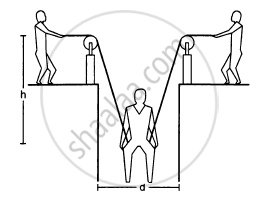
The force of buoyancy exerted by the atmosphere on a balloon is B in the upward direction and remains constant. The force of air resistance on the balloon acts opposite the direction of velocity and is proportional to it. The balloon carries a mass M and is found to fall to the earth's surface with a constant velocity v. How much mass should be removed from the balloon so that it may rise with a constant velocity v?
A force \[\vec{F} = \vec{v} \times \vec{A}\] is exerted on a particle in addition to the force of gravity, where \[\vec{v}\] is the velocity of the particle and \[\vec{A}\] is a constant vector in the horizontal direction. With what minimum speed, a particle of mass m be projected so that it continues to move without being defelected and with a constant velocity?
A tennis ball and a cricket ball , both are stationary. To start motion in them .
Two bodies A and B of same mass are moving with velocities v and 2v, respectively. Compare their (i) inertia and (ii) momentum.
How can Newton's first law of motion be obtained from the second law of motion?
A force acts for 10 s on a stationary body of mass 100 kg, after which the force ceases to act. The body moves through a distance of 100 m in the next 5 s. Calculate: The velocity acquired by the body.
Use Newton's second law to explain the following:
We always prefer to land on sand instead of hard floor while taking a high jump.
A ball is thrown vertically downward with an initial velocity of 10 m/s. What is its speed 1 s later and 2 s later?
A stone is dropped from a tower 98 m high. With what speed should a second stone be thrown 1 s later so that both hit the ground at the same time?
What do you mean by the conservation of momentum? Briefly, explain the collision between two bodies and the conservation of momentum.
A body of mass 2 kg travels according to the law x(t) = pt + qt2 + rt3 where p = 3 ms−1, q = 4 ms−2 and r = 5 ms−3. The force acting on the body at t = 2 seconds is ______.
