Advertisements
Advertisements
Question
How long will a stone take to fall to the ground from the top of a building 80 m high
Advertisements
Solution
Height, s = 80m
g = 10 m/s2
Using the second equation of motion,
S = ut + (1/2) gt2
Or, 80 = 0+ (1/2) (10) (t) 2
Or, (t) 2 = 16
Or, t = 4s
APPEARS IN
RELATED QUESTIONS
A constant retarding force of 50 N is applied to a body of mass 20 kg moving initially with a speed of 15 ms–1. How long does the body take to stop?
A man has fallen into a ditch of width d and two of his friends are slowly pulling him out using a light rope and two fixed pulleys as shown in the following figure. Show that the force (assumed equal for both the friends) exerted by each friend on the road increases as the man moves up. Find the force when the man is at a depth h.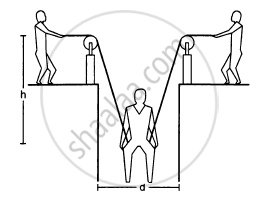
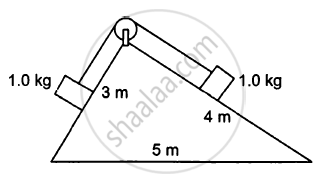
Consider the situation shown in the following figure All the surfaces are frictionless and the string and the pulley are light. Find the magnitude of acceleration of the two blocks.
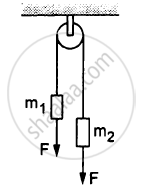
In the following figure, m1 = 5 kg, m2 = 2 kg and F = 1 N. Find the acceleration of either block. Describe the motion of m1 if the string breaks but F continues to act.
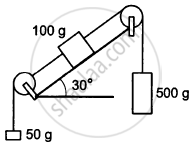
Find the acceleration of the 500 g block in the following figure.
Calculate the velocity of a body of mass 0.5 kg, when it has a linear momentum of 5 Ns.
Which of the following has the largest inertia?
Why is it advantageous to turn before taking a long jump?
Use Newton's second law to explain the following:
While catching a fast moving ball, we always pull our hands backwards.
A woman throws an object of mass 500 g with a speed of 25 ms1.
- What is the impulse imparted to the object?
- If the object hits a wall and rebounds with half the original speed, what is the change in momentum of the object?
