Advertisements
Advertisements
Question
Two bodies of masses 10 kg and 20 kg respectively kept on a smooth, horizontal surface are tied to the ends of a light string. A horizontal force F = 600 N is applied to
- A,
- B along the direction of string. What is the tension in the string in each case?
Advertisements
Solution
Horizontal force, F = 600 N
Mass of body A, m1 = 10 kg
Mass of body B, m2 = 20 kg
Total mass of the system, m = m1 + m2 = 30 kg
Using Newton’s second law of motion, the acceleration (a) produced in the system can be calculated as:
F = ma
`:.a = F/m = 600/30 = 20 "m/s"^2`
(i) When force F is applied to body A:
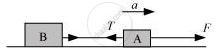
The equation of motion can be written as:
F-T = m1a
T = F - m1a
= 600 – 10 × 20 = 400 N
(ii) When force F is applied to body B:
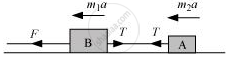
The equation of motion can be written as:
F – T = m2a
T = F – m2a
∴T = 600 – 20 × 20 = 200 N
APPEARS IN
RELATED QUESTIONS
A constant retarding force of 50 N is applied to a body of mass 20 kg moving initially with a speed of 15 ms–1. How long does the body take to stop?
Explain why a cricketer moves his hands backwards while holding a catch.
Two objects A and B are thrown upward simultaneously with the same speed. The mass of A is greater than that of B. Suppose the air exerts a constant and equal force of resistance on the two bodies.
A person says that he measured the acceleration of a particle to be non-zero even though no force was acting on the particle.
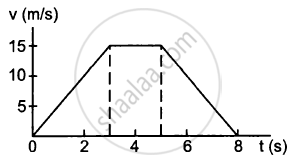
A particle of mass 50 g moves in a straight line. The variation of speed with time is shown in the following figure. Find the force acting on the particle at t = 2, 4 and 6 seconds.
A man has fallen into a ditch of width d and two of his friends are slowly pulling him out using a light rope and two fixed pulleys as shown in the following figure. Show that the force (assumed equal for both the friends) exerted by each friend on the road increases as the man moves up. Find the force when the man is at a depth h.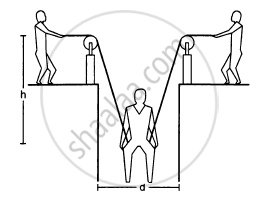
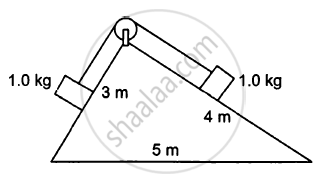
Consider the situation shown in the following figure All the surfaces are frictionless and the string and the pulley are light. Find the magnitude of acceleration of the two blocks.
Define linear momentum and state its S.I. unit.
The correct form of Newton's second law is :
The linear momentum of a body of mass m moving with velocity v is :
The linear momentum of a ball of mass 50 g is 0.5 kg m s-1. Find its velocity.
A force of 10 N acts on a body of mass 2 kg for 3 s, initially at rest. Calculate : Change in momentum of the body.
A ball is thrown vertically upwards. It returns 6 s later. Calculate the greatest height reached by the ball. (Take g = 10 m s−2)
A motorcycle of mass 100 kg is running at 10 ms−1. If its engine develops an extra linear momentum of 2000 Ns, calculate the new velocity of a motorcycle.
What do you understand by the term momentum?
What do you mean by linear momentum of a body?
A stone is thrown vertically upward with a velocity of 9.8 m/s. When will it reach the ground?
The INCORRECT statement about Newton's second law of motion is
Figure shows (x, t), (y, t ) diagram of a particle moving in 2-dimensions.
|
|
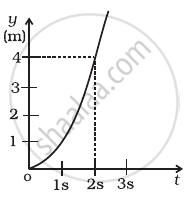 (b) |
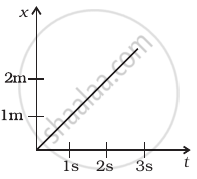
If the particle has a mass of 500 g, find the force (direction and magnitude) acting on the particle.
According to Newton's Second Law of Motion, what quantity is directly proportional to the applied force?
