Advertisements
Advertisements
Question
A car is moving with a uniform velocity 30 ms-1. It is stopped in 2 s by applying a force of 1500 N through its brakes. Calculate the following values : The change in momentum of car.
Advertisements
Solution
Initial velocity, u = 30 m/s
Final velocity, v = 0
Time, t = 2s
Force, F = 1500 N
Here, a = (v - u)/t = (0 - 30)/ 2 = - 15 ms-2. Here, negative sign indicates retardation.
Now, F = ma.
Or, m = F/a = (1500/ 15) = 100 kg.
Change in momentum = Final momentum - Initial momentum
Or, Δp = m (v - u)
Or, Δp = 100 (0 - 30)
Or, Δp = 3000 kg m/s-1
APPEARS IN
RELATED QUESTIONS
A smooth wedge A is fitted in a chamber hanging from a fixed ceiling near the earth's surface. A block B placed at the top of the wedge takes time T to slide down the length of the wedge. If the block is placed at the top of the wedge and the cable supporting the chamber is broken at the same instant, the block will.
In a TV picture tube, electrons are ejected from the cathode with negligible speed and they attain a velocity of 5 × 10⁶ m/s in travelling one centimetre. Assuming straight-line motion, find the constant force exerted on the electrons. The mass of an electron is 9.1 × 10⁻³¹ kg.
Suppose the ceiling in the previous problem is that of an elevator which is going up with an acceleration of 2.0 m/s2. Find the elongation.
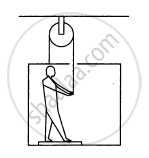
In the following figure shows a man of mass 60 kg standing on a light weighing machine kept in a box of mass 30 kg. The box is hanging from a pulley fixed to the ceiling by a light rope, the other end of which is held by the man himself. If the man manages to keep the box at rest, what is the weight recorded on the machine? What force should he exert on the rope to record his correct weight on the machine?
The linear momentum of a ball of mass 50 g is 0.5 kg m s-1. Find its velocity.
A pebble is dropped freely in a well from its top. It takes 20 s for the pebble to reach the water surface in the well. Taking g = 10 m s-2 and speed of sound = 330 m s-1. Find : The depth of water surface
A pebble is dropped freely in a well from its top. It takes 20 s for the pebble to reach the water surface in the well. Taking g = 10 m s-2 and speed of sound = 330 m s-1. Find : The time when echo is heard after the pebble is dropped.
Calculate the velocity of a body of mass 0.5 kg, when it has a linear momentum of 5 Ns.
State Newton's second law of motion. Is Newton's first law of motion contained in Newton's second law of motion?
A cricket ball of mass 150 g has an initial velocity `u = (3hati + 4hatj)` m s−1 and a final velocity `v = - (3hati + 4hatj)` m s−1 after being hit. The change in momentum (final momentum-initial momentum) is (in kg m s1)
