Advertisements
Advertisements
Question
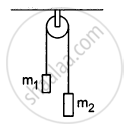
In a simple Atwood machine, two unequal masses m1 and m2 are connected by a string going over a clamped light smooth pulley. In a typical arrangement (In the following figure), m1 = 300 g and m2 = 600 g. The system is released from rest. (a) Find the distance travelled by the first block in the first two seconds; (b) find the tension in the string; (c) find the force exerted by the clamp on the pulley.
Advertisements
Solution
The masses of the blocks are m1 = 0.3 kg and m2 = 0.6 kg
The free-body diagrams of both the masses are shown below: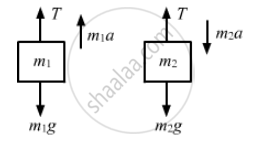
For mass m1,
T − m1g = m1a ...(i)
For mass m2,
m2g − T= m2a ...(ii)
Adding equations (i) and (ii), we get:
g(m2 − m1) = a(m1 + m2)
\[\Rightarrow a = g{\left( \frac{m_2 - m_1}{m_1 + m_2} \right)}$\]
\[ = 9 . 8 \times \frac{0 . 6 - 0 . 3}{0 . 6 + 0 . 3}\]
\[ = 3 . 266 m/ s^2\]
(a) t = 2 s, a = 3.266 ms−2, u = 0
So, the distance travelled by the body,
\[S = ut + \frac{1}{2}a t^2 \]
\[ = 0 + \frac{1}{2}\left( 3 . 266 \right) 2^2 = 6 . 5 m\]
(b) From equation (i),
T = m1 (g + a)
= 0.3 (9.8 + 3.26) = 3.9 N
(c)The force exerted by the clamp on the pulley,
F = 2T = 2 × 3.9 = 7.8 N
APPEARS IN
RELATED QUESTIONS
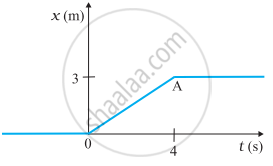
The below figure shows the position-time graph of a particle of mass 4 kg.
- What is the force on the particle for t < 0, t > 4 s, 0 < t < 4 s?
- What is the impulse at t = 0 and t = 4 s? (Consider one-dimensional motion only.)
A stone of mass m tied to the end of a string revolves in a vertical circle of radius R. The net forces at the lowest and highest points of the circle directed vertically downwards are: [Choose the correct alternative]
| Lowest Point | Highest Point | |
| a) | mg – T1 | mg + T2 |
| b) | mg + T1 | mg – T2 |
| c) | `mg + T1 –(m_v_1^2)/R` | mg – T2 + (`mv_1^2`)/R |
| d) | `mg – T1 – (mv)/R` | mg + T2 + (mv_1^2)/R |
T1 and v1 denote the tension and speed at the lowest point. T2 and v2 denote corresponding values at the highest point.
When a horse pulls a cart, the force that helps the horse to move forward is the force exerted by
The figure shows the displacement of a particle going along the X-axis as a function of time. The force acting on the particle is zero in the region
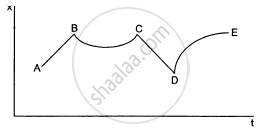
(a) AB
(b) BC
(c) CD
(d) DE
Two blocks of equal mass m are tied to each other through a light string. One of the blocks is pulled along the line joining them with a constant force F. Find the tension in the string joining the blocks.
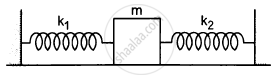
Both the springs shown in the following figure are unstretched. If the block is displaced by a distance x and released, what will be the initial acceleration?
The force of buoyancy exerted by the atmosphere on a balloon is B in the upward direction and remains constant. The force of air resistance on the balloon acts opposite the direction of velocity and is proportional to it. The balloon carries a mass M and is found to fall to the earth's surface with a constant velocity v. How much mass should be removed from the balloon so that it may rise with a constant velocity v?
Consider the Atwood machine of the previous problem. The larger mass is stopped for a moment, 2.0 s after the system is set into motion. Find the time that elapses before the string is tight again.
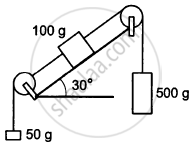
Find the acceleration of the 500 g block in the following figure.
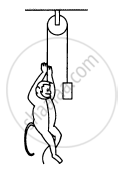
A monkey of mass 15 kg is climbing a rope fixed to a ceiling. If it wishes to go up with an acceleration of 1 m/s2, how much force should it apply on the rope? If the rope is 5 m long and the monkey starts from rest, how much time will it take to reach the ceiling?
A monkey is climbing on a rope that goes over a smooth light pulley and supports a block of equal mass at the other end in the following figure. Show that whatever force the monkey exerts on the rope, the monkey and the block move in the same direction with equal acceleration. If initially both were at rest, their separation will not change as time passes.
State the Newton's second law of motion. What information do you get from it?
ame the law of motion which gives the definition of force.
What do you mean by linear momentum of a body?
Name the physical quantity which equals the rate of change of linear momentum.
Use Newton's second law to explain the following:
While catching a fast moving ball, we always pull our hands backwards.
A metre scale is moving with uniform velocity. This implies ______.
A hockey player is moving northward and suddenly turns westward with the same speed to avoid an opponent. The force that acts on the player is ______.
The motion of a particle of mass m is given by x = 0 for t < 0 s, x(t) = A sin 4 pt for 0 < t < (1/4) s (A > o), and x = 0 for t > (1/4) s. Which of the following statements is true?
- The force at t = (1/8) s on the particle is – 16π2 Am.
- The particle is acted upon by on impulse of magnitude 4π2 A m at t = 0 s and t = (1/4) s.
- The particle is not acted upon by any force.
- The particle is not acted upon by a constant force.
- There is no impulse acting on the particle.
What happens when a car brakes to come to a stop?
