Advertisements
Advertisements
Question
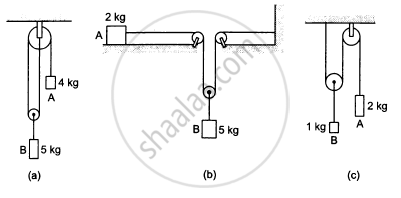
Find the acceleration of the blocks A and B in the three situations shown in the following figure.
Advertisements
Solution
(a) 5a + T − 5g = 0
From free-body diagram (1),
T = 5g − 5a .....(i)
Again,
\[\left( \frac{1}{2} \right)T - 4g - 8a = 0\]
⇒ T − 8g − 16a = 0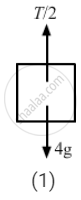
From free-body diagram (2),
T = 8g + 16a ......(ii)
From equations (i) and (ii), we get:
5g − 5a = 8g + 16a
\[\Rightarrow 21a = - 3g - a = - \frac{9}{7}\]
So, the acceleration of the 5 kg mass is \[\frac{9}{7} m/ s^2 \left(\text{ upward }\right)\] and that of the 4 kg mass is
\[2a = \frac{2g}{7} \left(\text{ downward }\right)\]
\[4a - \frac{T}{2} = 0\]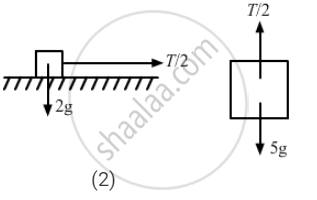
⇒ 8a − T = 0
⇒ T = 8a
Again, T + 5a − 5g = 0
From free body diagram-4,
8a + 5a − 5g = s0
⇒ 13a − 5g = 0
\[\Rightarrow a = \frac{5g}{13} \left(\text{ downward }\right)\]
Acceleration of mass 2 kg is \[2a = \frac{10}{13} \left( g \right)\] and 5 kg is
\[\frac{5g}{13}\].
(c) T + 1a − 1g = 0
From free body diagram-5
T = 1g − 1a .....(i)
Again, from free body diagram-6,
\[\frac{T}{2} - 2g - 4a = 0\]
⇒ T − 4g − 8a = 0 .....(ii)
From equation (i)
1g − 1a − 4g − 8a = 0
\[\Rightarrow a = \frac{g}{3}\left(\text{ downward }\right)\]
Acceleration of mass 1 kg is \[\frac{g}{3} \left(\text{ upward }\right)\]
Acceleration of mass 2 kg is \[\frac{2g}{3} \left(\text{ downward }\right)\] 
APPEARS IN
RELATED QUESTIONS
A body of mass 0.40 kg moving initially with a constant speed of 10 m s–1 to the north is subject to a constant force of 8.0 N directed towards the south for 30 s. Take the instant the force is applied to be t = 0, the position of the body at that time to be x = 0, and predict its position at t = –5 s, 25 s, 100 s.
A man of mass 70 kg stands on a weighing scale in a lift which is moving
- upwards with a uniform speed of 10 m s-1
- downwards with a uniform acceleration of 5 m s–2
- upwards with a uniform acceleration of 5 m s–2. What would be the readings on the scale in each case?
- What would be the reading if the lift mechanism failed and it hurtled down freely under gravity?
Two bodies of masses 10 kg and 20 kg respectively kept on a smooth, horizontal surface are tied to the ends of a light string. A horizontal force F = 600 N is applied to
- A,
- B along the direction of string. What is the tension in the string in each case?
An aircraft executes a horizontal loop at a speed of 720 km/h with its wings banked at 15°. What is the radius of the loop?
Suppose you are running fast in a field and suddenly find a snake in front of you. You stop quickly. Which force is responsible for your deceleration?
When a horse pulls a cart, the force that helps the horse to move forward is the force exerted by
A car accelerates on a horizontal road due to the force exerted by.
The figure shows the displacement of a particle going along the X-axis as a function of time. The force acting on the particle is zero in the region
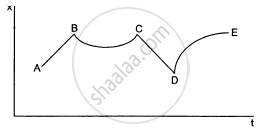
(a) AB
(b) BC
(c) CD
(d) DE
car moving at 40 km/hr is to be stopped by applying brakes in the next 4 m. If the car weighs 2000 kg, what average force must be applied to stop it?
A block of mass 0.2 kg is suspended from the ceiling by a light string. A second block of mass 0.3 kg is suspended from the first block by another string. Find the tensions in the two strings. Take g = 10 m/s2.
Two balls A and B of masses m and 2 m are in motion with velocities 2v and v, respectively. Compare:
(i) Their inertia.
(ii) Their momentum.
(iii) The force needed to stop them in the same time.
How can Newton's first law of motion be obtained from the second law of motion?
A force acts for 10 s on a stationary body of mass 100 kg, after which the force ceases to act. The body moves through a distance of 100 m in the next 5 s. Calculate : The magnitude of the force
How long will a stone take to fall to the ground from the top of a building 80 m high
A stone is dropped freely from the top of a tower and it reaches the ground in 4 s. Taking g = 10m s-2, calculate the height of the tower.
Calculate the velocity of a body of mass 0.5 kg, when it has a linear momentum of 5 Ns.
Name the physical entity used for quantifying the motion of a body.
Which of the following has the largest inertia?
Use Newton's second law to explain the following:
While catching a fast moving ball, we always pull our hands backwards.
Why is catching a slow-moving ball easier than catching a fast-moving ball?
