Advertisements
Advertisements
Question
Name the physical quantity which equals the rate of change of linear momentum.
Advertisements
Solution
Force is equal to the rate of change of linear momentum.
APPEARS IN
RELATED QUESTIONS
Two masses 8 kg and 12 kg are connected at the two ends of a light, inextensible string that goes over a frictionless pulley. Find the acceleration of the masses, and the tension in the string when the masses are released.
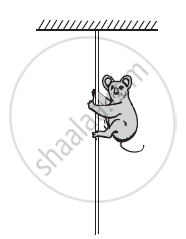
A monkey of mass 40 kg climbs on a rope in given Figure which can stand a maximum tension of 600 N. In which of the following cases will the rope break: the monkey
(a) climbs up with an acceleration of 6 m s–2
(b) climbs down with an acceleration of 4 m s–2
(c) climbs up with a uniform speed of 5 m s–1
(d) falls down the rope nearly freely under gravity?
(Ignore the mass of the rope).
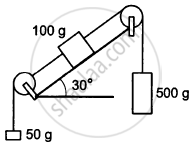
Find the acceleration of the 500 g block in the following figure.
Two bodies A and B of same mass are moving with velocities v and 2v, respectively. Compare their (i) inertia and (ii) momentum.
State the Newton's second law of motion. What information do you get from it?
The correct form of Newton's second law is :
A force acts for 10 s on a stationary body of mass 100 kg, after which the force ceases to act. The body moves through a distance of 100 m in the next 5 s. Calculate: The velocity acquired by the body.
What do you understand by the term momentum?
A stone is dropped from a cliff 98 m high.
How long will it take to fall to the foot of the cliff?
A woman throws an object of mass 500 g with a speed of 25 ms1.
- What is the impulse imparted to the object?
- If the object hits a wall and rebounds with half the original speed, what is the change in momentum of the object?
