Advertisements
Advertisements
Question
State Newton's second law of motion. Is Newton's first law of motion contained in Newton's second law of motion?
Advertisements
Solution
According to newton's second law of motion, when a force acts on a body, the rate of change in momentum of a body is equal to the product of the mass of the body and acceleration produced in it.
Yes, Newton's first law is contained in the second law as if force is zero then the acceleration would be zero which means the body would remain in its state of rest or in state of constant motion.
APPEARS IN
RELATED QUESTIONS
When a horse pulls a cart, the force that helps the horse to move forward is the force exerted by
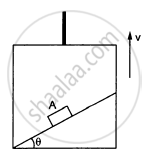
A block A can slide on a frictionless incline of angle θ and length l, kept inside an elevator going up with uniform velocity v in the following figure. Find the time taken by the block to slide down the length of the incline if it is released from the top of the incline.
A block is kept on the floor of an elevator at rest. The elevator starts descending with an acceleration of 12 m/s2. Find the displacement of the block during the first 0.2 s after the start. Take g = 10 m/s2.
A car is moving with a uniform velocity 30 ms-1. It is stopped in 2 s by applying a force of 1500 N through its brakes. Calculate the following values : The change in momentum of car.
How long will a stone take to fall to the ground from the top of a building 80 m high
A body of mass 200 g is moving with a velocity of 5 ms−1. If the velocity of the body changes to 17 ms−1, calculate the change in linear momentum of the body.
Name the physical entity used for quantifying the motion of a body.
A hockey player is moving northward and suddenly turns westward with the same speed to avoid an opponent. The force that acts on the player is ______.
The motion of a particle of mass m is given by x = 0 for t < 0 s, x(t) = A sin 4 pt for 0 < t < (1/4) s (A > o), and x = 0 for t > (1/4) s. Which of the following statements is true?
- The force at t = (1/8) s on the particle is – 16π2 Am.
- The particle is acted upon by on impulse of magnitude 4π2 A m at t = 0 s and t = (1/4) s.
- The particle is not acted upon by any force.
- The particle is not acted upon by a constant force.
- There is no impulse acting on the particle.
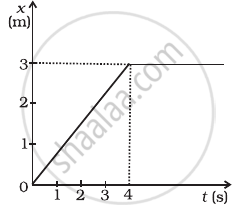
The position time graph of a body of mass 2 kg is as given in figure. What is the impulse on the body at t = 0 s and t = 4 s.