Advertisements
Advertisements
प्रश्न
State Newton's second law of motion. Is Newton's first law of motion contained in Newton's second law of motion?
Advertisements
उत्तर
According to newton's second law of motion, when a force acts on a body, the rate of change in momentum of a body is equal to the product of the mass of the body and acceleration produced in it.
Yes, Newton's first law is contained in the second law as if force is zero then the acceleration would be zero which means the body would remain in its state of rest or in state of constant motion.
APPEARS IN
संबंधित प्रश्न
A helicopter of mass 1000 kg rises with a vertical acceleration of 15 m s–2. The crew and the passengers weigh 300 kg. Give the magnitude and direction of the
(a) force on the floor by the crew and passengers,
(b) action of the rotor of the helicopter on the surrounding air,
(c) force on the helicopter due to the surrounding air.
The force of buoyancy exerted by the atmosphere on a balloon is B in the upward direction and remains constant. The force of air resistance on the balloon acts opposite the direction of velocity and is proportional to it. The balloon carries a mass M and is found to fall to the earth's surface with a constant velocity v. How much mass should be removed from the balloon so that it may rise with a constant velocity v?
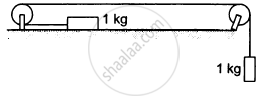
Calculate the tension in the string shown in the following figure. The pulley and the string are light and all the surfaces are frictionless. Take g = 10 m/s2.
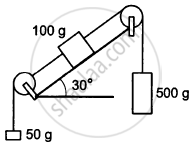
Find the acceleration of the 500 g block in the following figure.
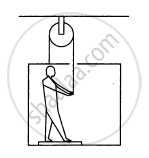
In the following figure shows a man of mass 60 kg standing on a light weighing machine kept in a box of mass 30 kg. The box is hanging from a pulley fixed to the ceiling by a light rope, the other end of which is held by the man himself. If the man manages to keep the box at rest, what is the weight recorded on the machine? What force should he exert on the rope to record his correct weight on the machine?
Two balls A and B of masses m and 2 m are in motion with velocities 2v and v, respectively. Compare:
(i) Their inertia.
(ii) Their momentum.
(iii) The force needed to stop them in the same time.
The correct form of Newton's second law is :
A body of mass 5 kg is moving with velocity 2 m s-1. Calculate its linear momentum.
A force acts for 10 s on a stationary body of mass 100 kg, after which the force ceases to act. The body moves through a distance of 100 m in the next 5 s. Calculate: The velocity acquired by the body.
A stone is dropped from a cliff 98 m high.
What will be its speed when it strikes the ground?
