Advertisements
Advertisements
प्रश्न
Define Newton’s second law of motion.
Advertisements
उत्तर
Newton’s second law of motion states that the rate of change of momentum is directly proportional to force applied and takes place in the direction of the force.
APPEARS IN
संबंधित प्रश्न
Two blocks of equal mass m are tied to each other through a light string. One of the blocks is pulled along the line joining them with a constant force F. Find the tension in the string joining the blocks.
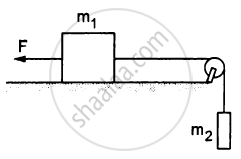
A constant force F = m2g/2 is applied on the block of mass m1 as shown in the following figure. The string and the pulley are light and the surface of the table is smooth. Find the acceleration of m1.
Two balls A and B of masses m and 2 m are in motion with velocities 2v and v, respectively. Compare:
(i) Their inertia.
(ii) Their momentum.
(iii) The force needed to stop them in the same time.
A body of mass 5 kg is moving with velocity 2 m s-1. Calculate its linear momentum.
A force acts for 10 s on a stationary body of mass 100 kg, after which the force ceases to act. The body moves through a distance of 100 m in the next 5 s. Calculate: The velocity acquired by the body.
How long will a stone take to fall to the ground from the top of a building 80 m high
A stone is dropped freely from the top of a tower and it reaches the ground in 4 s. Taking g = 10m s-2, calculate the height of the tower.
What do you mean by an impulsive force?
A stone is dropped from a cliff 98 m high.
What will be its speed when it strikes the ground?
In the previous problem (5.3), the magnitude of the momentum transferred during the hit is ______.
