Advertisements
Advertisements
प्रश्न
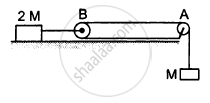
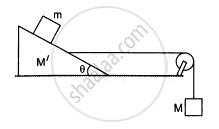
Consider the situation shown in the following figure. Both the pulleys and the string are light and all the surfaces are frictionless.
- Find the acceleration of the mass M.
- Find the tension in the string.
- Calculate the force exerted by the clamp on the pulley A in the figure.
Advertisements
उत्तर
Let the acceleration of mass M be a.
So, the acceleration of mass 2M will be \[\frac{a}{2}\]
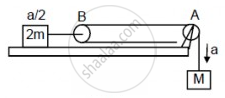
(a)
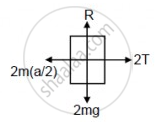
2M(a/2) − 2T = 0
⇒ Ma = 2T
T + Ma − Mg = 0
\[\Rightarrow \frac{Ma}{2} + Ma = Mg \]
\[ \Rightarrow 3Ma = 2Mg\]
\[ \Rightarrow a = \frac{2g}{3}\]
(b) Tension,
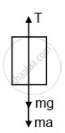
\[T = \frac{Ma}{2} = \frac{M}{2} \times \frac{2g}{3} = \frac{Mg}{3}\]
(c)
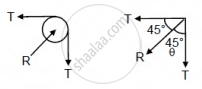
Let T' = resultant of tensions
\[\therefore T' = \sqrt{T^2 + T^2} = \sqrt{2}T\]
\[ \therefore T' = \sqrt{2}T = \frac{\sqrt{2}Mg}{3}\]
\[\text{Again, }\tan\theta = \frac{T}{T} = 1\]
\[ \Rightarrow \theta = 45^\circ\]
So, it is `(sqrt2"Mg")/3` at an angle of 45° with the horizontal.
That is the force exerted by the clamp.
APPEARS IN
संबंधित प्रश्न
An aircraft executes a horizontal loop at a speed of 720 km/h with its wings banked at 15°. What is the radius of the loop?
Suppose you are running fast in a field and suddenly find a snake in front of you. You stop quickly. Which force is responsible for your deceleration?
If the tension in the cable supporting an elevator is equal to the weight of the elevator, the elevator may be
(a) going up with increasing speed
(b) going down with increasing speed
(c) going up with uniform speed
(d) going down with uniform speed
A particle of mass 0.3 kg is subjected to a force F = −kx with k = 15 N/m. What will be its initial acceleration if it is released from a point x = 20 cm?
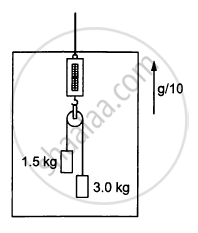
Find the reading of the spring balance shown in the following figure. The elevator is going up with an acceleration g/10, the pulley and the string are light and the pulley is smooth.
The force of buoyancy exerted by the atmosphere on a balloon is B in the upward direction and remains constant. The force of air resistance on the balloon acts opposite the direction of velocity and is proportional to it. The balloon carries a mass M and is found to fall to the earth's surface with a constant velocity v. How much mass should be removed from the balloon so that it may rise with a constant velocity v?
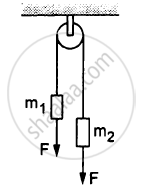
In the following figure, m1 = 5 kg, m2 = 2 kg and F = 1 N. Find the acceleration of either block. Describe the motion of m1 if the string breaks but F continues to act.
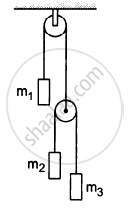
Let m1 = 1 kg, m2 = 2 kg and m3 = 3 kg in the following figure. Find the accelerations of m1, m2 and m3. The string from the upper pulley to m1 is 20 cm when the system is released from rest. How long will it take before m1 strikes the pulley?
Find the mass M of the hanging block in the following figure that will prevent the smaller block from slipping over the triangular block. All the surfaces are frictionless and the strings and the pulleys are light.
The linear momentum of a body of mass m moving with velocity v is :
A car is moving with a uniform velocity 30 ms-1. It is stopped in 2 s by applying a force of 1500 N through its brakes. Calculate the following values : The change in momentum of car.
A bullet of mass 50 g moving with an initial velocity 100 m s-1 strikes a wooden block and comes to rest after penetrating a distance 2 cm in it. Calculate: (i) Initial momentum of the bullet, (ii) Final momentum of the bullet, (iii) Retardation caused by the wooden block and (iv) Resistive force exerted by the wooden block.
Multiple Choice Question. Select the correct option.
Which of the following are vector quantities?
Name the physical entity used for quantifying the motion of a body.
Why is it advantageous to turn before taking a long jump?
The motion of a particle of mass m is given by x = 0 for t < 0 s, x(t) = A sin 4 pt for 0 < t < (1/4) s (A > o), and x = 0 for t > (1/4) s. Which of the following statements is true?
- The force at t = (1/8) s on the particle is – 16π2 Am.
- The particle is acted upon by on impulse of magnitude 4π2 A m at t = 0 s and t = (1/4) s.
- The particle is not acted upon by any force.
- The particle is not acted upon by a constant force.
- There is no impulse acting on the particle.
A woman throws an object of mass 500 g with a speed of 25 ms1.
- What is the impulse imparted to the object?
- If the object hits a wall and rebounds with half the original speed, what is the change in momentum of the object?
