Advertisements
Advertisements
प्रश्न
Show that the rate of change of momentum = mass × acceleration. Under what condition does this relation hold?
Advertisements
उत्तर १
Let a force 'F' be applied on a body of mass m for a time 't' due to which its velocity changes from u to v. Then,
Initial momentum of body = mu
Final momentum of body = mv
Change in momentum of the body in 't' seconds = mv - mu = m (v - u)
Rate of change of momentum = Change in momentum/time
= [m (v - u)]/t
However, acceleration a = Change in velocity/time = (v - u)/t
Therefore, rate of change of momentum = ma = mass × acceleration
This relation holds true when the mass of the body remains constant.
उत्तर २
According to newton second law
F = m X a
a= (v - u)/t.
F = m(v -u)/t
F = (mv - mu)/t
As F= m X a
ma = (mv - mu)/t
so rate of change of momentum = mass X acceleration.
This relation holds good when mass remains constant during motion.
संबंधित प्रश्न
Explain why a cricketer moves his hands backwards while holding a catch.
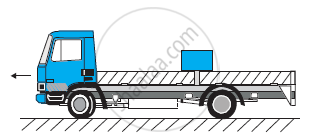
The rear side of a truck is open and a box of 40 kg mass is placed 5 m away from the open end as shown in Figure. The coefficient of friction between the box and the surface below it is 0.15. On a straight road, the truck starts from rest and accelerates with 2 m s–2. At what distance from the starting point does the box fall off the truck? (Ignore the size of the box).
A spy jumps from an airplane with his parachute. The spy accelerates downward for some time when the parachute opens. The acceleration is suddenly checked and the spy slowly falls to the ground. Explain the action of the parachute in checking the acceleration.
The figure shows the displacement of a particle going along the X-axis as a function of time. The force acting on the particle is zero in the region
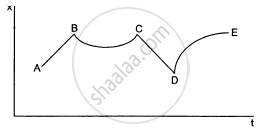
(a) AB
(b) BC
(c) CD
(d) DE
The force of buoyancy exerted by the atmosphere on a balloon is B in the upward direction and remains constant. The force of air resistance on the balloon acts opposite the direction of velocity and is proportional to it. The balloon carries a mass M and is found to fall to the earth's surface with a constant velocity v. How much mass should be removed from the balloon so that it may rise with a constant velocity v?
State the Newton's second law of motion. What information do you get from it?
A ball is thrown vertically upwards. It returns 6 s later. Calculate the greatest height reached by the ball. (Take g = 10 m s−2)
An electron of mass 9 × 10⁻³¹ kg is moving with a linear velocity of 6 × 10⁷ ms−1. Calculate the linear momentum of electron.
According to Newton's Second Law of Motion, what quantity is directly proportional to the applied force?
Why is catching a slow-moving ball easier than catching a fast-moving ball?
