Advertisements
Advertisements
प्रश्न
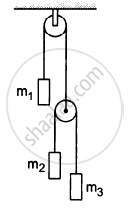
Let m1 = 1 kg, m2 = 2 kg and m3 = 3 kg in the following figure. Find the accelerations of m1, m2 and m3. The string from the upper pulley to m1 is 20 cm when the system is released from rest. How long will it take before m1 strikes the pulley?
Advertisements
उत्तर
The free-body diagram for mass m1 is shown below: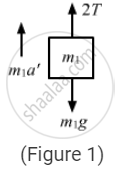 a
a
The free-body diagram for mass m2 is shown below: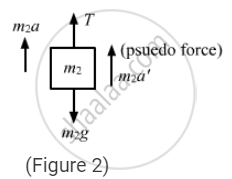
The free-body diagram for mass m3 is shown below: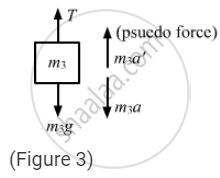
Suppose the block m1 moves upward with acceleration a1 and the blocks m2 and m3have relative acceleration a2 due to the difference of weight between them.
So, the actual acceleration of the blocks m1, m2 and m3 will be a1, (a1 − a2) and (a1 + a2), as shown.
From figure 2, T − 1g − 1a1 = 0 ...(i)
From figure 3,\[\frac{T}{2} - 2g - 2\left( a_1 - a_2 \right) = 0 . . . \left( ii \right)\]
From figure 4,\[\frac{T}{2} - 3g - 3\left( a_1 + a_2 \right) = 0 . . . \left( iii \right)\]
From equations (i) and (ii), eliminating T, we get:
1g + 1a2 = 4g + 4 (a1 + a2)
5a2 − 4a1 = 3g ...(iv)
From equations (ii) and (iii), we get:
2g + 2(a1 − a2) = 3g − 3 (a1 − a2)
5a1 + a2 = g ...(v)
Solving equations (iv) and (v), we get:
\[a_1 = \frac{2g}{29}\]
\[\text{ and }a_2 = g - 5 a_1 \]
\[ \Rightarrow a_2 = g - \frac{10g}{29} = \frac{19g}{29}\]
\[\text{So}, a_1 - a_2 = \frac{2g}{29} - \frac{19g}{29} = - \frac{17g}{29}\]
So, accelerations of m1, m2 and m3 are \[\frac{19g}{29}\left( up \right),
\frac{17g}{29} \left(\text{ down }\right)\text{ and }\frac{21g}{29}\left(\text{ down }\right)\]
Now, u = 0, s = 20 cm = 0.2 m
\[a_2 = \frac{19g}{29} \]
\[ \therefore s = ut + \frac{1}{2}a t^2 \]
\[ \Rightarrow 0 . 2 = \frac{1}{2} \times \frac{19}{29}g t^2 \]
\[ \Rightarrow t = 0 . 25 s\]
APPEARS IN
संबंधित प्रश्न
A man of mass 70 kg stands on a weighing scale in a lift which is moving
- upwards with a uniform speed of 10 m s-1
- downwards with a uniform acceleration of 5 m s–2
- upwards with a uniform acceleration of 5 m s–2. What would be the readings on the scale in each case?
- What would be the reading if the lift mechanism failed and it hurtled down freely under gravity?
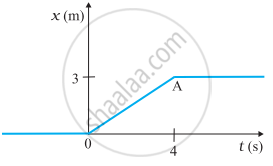
The below figure shows the position-time graph of a particle of mass 4 kg.
- What is the force on the particle for t < 0, t > 4 s, 0 < t < 4 s?
- What is the impulse at t = 0 and t = 4 s? (Consider one-dimensional motion only.)
A batsman deflects a ball by an angle of 45° without changing its initial speed which is equal to 54 km/h. What is the impulse imparted to the ball? (Mass of the ball is 0.15 kg.)
An aircraft executes a horizontal loop at a speed of 720 km/h with its wings banked at 15°. What is the radius of the loop?
A car accelerates on a horizontal road due to the force exerted by.
A particle of mass 0.3 kg is subjected to a force F = −kx with k = 15 N/m. What will be its initial acceleration if it is released from a point x = 20 cm?
Suppose the ceiling in the previous problem is that of an elevator which is going up with an acceleration of 2.0 m/s2. Find the elongation.
A force \[\vec{F} = \vec{v} \times \vec{A}\] is exerted on a particle in addition to the force of gravity, where \[\vec{v}\] is the velocity of the particle and \[\vec{A}\] is a constant vector in the horizontal direction. With what minimum speed, a particle of mass m be projected so that it continues to move without being defelected and with a constant velocity?
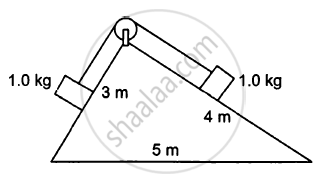
Consider the situation shown in the following figure All the surfaces are frictionless and the string and the pulley are light. Find the magnitude of acceleration of the two blocks.
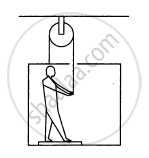
In the following figure shows a man of mass 60 kg standing on a light weighing machine kept in a box of mass 30 kg. The box is hanging from a pulley fixed to the ceiling by a light rope, the other end of which is held by the man himself. If the man manages to keep the box at rest, what is the weight recorded on the machine? What force should he exert on the rope to record his correct weight on the machine?
Show that the rate of change of momentum = mass × acceleration. Under what condition does this relation hold?
Define Newton’s second law of motion.
Multiple Choice Question. Select the correct option.
The impulse of a body is equal to:
Multiple Choice Question. Select the correct option.
A force acts on a body of mass 3 kg such that its velocity changes from 4 ms−1 to 10 ms−1. The change in momentum of the body is
What do you mean by linear momentum of a body?
A stone is thrown vertically upward with a velocity of 9.8 m/s. When will it reach the ground?
A woman throws an object of mass 500 g with a speed of 25 ms1.
- What is the impulse imparted to the object?
- If the object hits a wall and rebounds with half the original speed, what is the change in momentum of the object?
