Advertisements
Advertisements
प्रश्न
A stone is dropped from a tower 98 m high. With what speed should a second stone be thrown 1 s later so that both hit the ground at the same time?
Advertisements
उत्तर
Height of tower = 98 m
Acceleration due to gravity on stone = 9.8 ms-2.
Initial speed of ball= 0 ms-1.
Let initial speed of second stone is v ms-1.
We know from second equation of motion
S = ut + 1/2 a Xt2.
98 = 0 + 1/2 X9.8Xt2.
t2 = 20
t= 4.47 sec.
As second stone is thrown 1 sec later so time taken by second body to cover distance of 98 m is = 4.47 - 1 = 3.47sec.
So again put t= 3.47 sec and S = 98 m in second equation of motion we get
98 = vX3.47 + 1/2 X9.8X3.47X3.47.
98 = 3.47Xv + 59
3.47X v = 98 - 59
v= 39/3.47 = 11.23 ms-1.
Initial speed of second stone should be 11.23 ms-1.
APPEARS IN
संबंधित प्रश्न
Two masses 8 kg and 12 kg are connected at the two ends of a light, inextensible string that goes over a frictionless pulley. Find the acceleration of the masses, and the tension in the string when the masses are released.
In the previous problem, suppose m2 = 2.0 kg and m3 = 3.0 kg. What should be the mass m, so that it remains at rest?
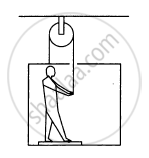
In the following figure shows a man of mass 60 kg standing on a light weighing machine kept in a box of mass 30 kg. The box is hanging from a pulley fixed to the ceiling by a light rope, the other end of which is held by the man himself. If the man manages to keep the box at rest, what is the weight recorded on the machine? What force should he exert on the rope to record his correct weight on the machine?
State the magnitude and direction of the force of gravity acting on the body of mass 5 kg. Take g = 9.8 m s-2.
A pebble is thrown vertically upwards with a speed of 20 m s-1. How high will it be after 2 s? (Take g = 10 m s-2)
State two factors which determine the momentum of a body.
What causes motion in a body?
In the previous problem (5.3), the magnitude of the momentum transferred during the hit is ______.
A body of mass 2 kg travels according to the law x(t) = pt + qt2 + rt3 where p = 3 ms−1, q = 4 ms−2 and r = 5 ms−3. The force acting on the body at t = 2 seconds is ______.
What happens when a car brakes to come to a stop?
