Newton’s Second Law corrected the old belief that force is needed to maintain motion. This idea came from the philosopher ______.
Advertisements
Advertisements
प्रश्न
A helicopter of mass 1000 kg rises with a vertical acceleration of 15 m s–2. The crew and the passengers weigh 300 kg. Give the magnitude and direction of the
(a) force on the floor by the crew and passengers,
(b) action of the rotor of the helicopter on the surrounding air,
(c) force on the helicopter due to the surrounding air.
Advertisements
उत्तर १
(a) Mass of the helicopter, mh = 1000 kg
Mass of the crew and passengers, mp = 300 kg
Total mass of the system, m = 1300 kg
Acceleration of the helicopter, a = 15 m/s2
Using Newton’s second law of motion, the reaction force R, on the system by the floor can be calculated as:
R – mpg = ma
= mp(g + a)
= 300 (10 + 15) = 300 × 25
= 7500 N
Since the helicopter is accelerating vertically upward, the reaction force will also be directed upward. Therefore, as per Newton’s third law of motion, the force on the floor by the crew and passengers is 7500 N, directed downward.
(b) Using Newton’s second law of motion, the reaction force R’, experienced by the helicopter can be calculated as:
R' - mg = ma
=m(g+a)
=1300(10+15) = 1300 xx 25
= 32500 N
The reaction force experienced by the helicopter from the surrounding air is acting upward. Hence, as per Newton’s third law of motion, the action of the rotor on the surrounding air will be 32500 N, directed downward.
(c) The force on the helicopter due to the surrounding air is 32500 N, directed upward.
shaalaa.com
उत्तर २
Here, mass of helicopter, m1= 1000 kg
Mass of the crew and passengers, m2 = 300 kg upward acceleration, a = 15 ms-2and g = 10 ms-2
(a)Force on the floor of helicopter by the crew and passengers = apparent weight of crew and passengers
= m2 (g + a) = 300 (10 + 15) N = 7500 N
(b)Action of rotor of helicopter on surrounding air is obviously vertically downwards, because helicopter rises on account of reaction to this force. Thus, force of action
F = (m1+ m2) (g + a) = (1000 + 300) (10 + 15) = 1300 x 25 = 32500 N
(c)Force on the helicopter due to surrounding air is the reaction. As action and reaction are equal and opposite, therefore, force of reaction, F = 32500 N, vertically upwards.
shaalaa.com
क्या इस प्रश्न या उत्तर में कोई त्रुटि है?
संबंधित प्रश्न
Two masses 8 kg and 12 kg are connected at the two ends of a light, inextensible string that goes over a frictionless pulley. Find the acceleration of the masses, and the tension in the string when the masses are released.
An object is placed far away from all the objects that can exert force on it. A frame of reference is constructed by taking the origin and axes fixed in this object. Will the frame be necessarily inertial?
When a horse pulls a cart, the force that helps the horse to move forward is the force exerted by
A block of mass m is placed on a smooth wedge of inclination θ. The whole system is accelerated horizontally so that the block does not slip on the wedge. The force exerted by the wedge on the block has a magnitude.
Two objects A and B are thrown upward simultaneously with the same speed. The mass of A is greater than that of B. Suppose the air exerts a constant and equal force of resistance on the two bodies.
The figure shows the displacement of a particle going along the X-axis as a function of time. The force acting on the particle is zero in the region
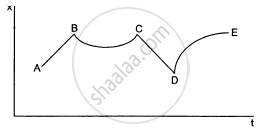
(a) AB
(b) BC
(c) CD
(d) DE
If the tension in the cable supporting an elevator is equal to the weight of the elevator, the elevator may be
(a) going up with increasing speed
(b) going down with increasing speed
(c) going up with uniform speed
(d) going down with uniform speed
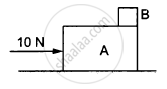
A small block B is placed on another block A of mass 5 kg and length 20 cm. Initially, the block B is near the right end of block A (In the following Figure). A constant horizontal force of 10 N is applied to the block A. All the surfaces are assumed frictionless. Find the time that elapses before block B separates from A.
A man has fallen into a ditch of width d and two of his friends are slowly pulling him out using a light rope and two fixed pulleys as shown in the following figure. Show that the force (assumed equal for both the friends) exerted by each friend on the road increases as the man moves up. Find the force when the man is at a depth h.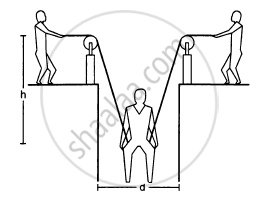
The force of buoyancy exerted by the atmosphere on a balloon is B in the upward direction and remains constant. The force of air resistance on the balloon acts opposite the direction of velocity and is proportional to it. The balloon carries a mass M and is found to fall to the earth's surface with a constant velocity v. How much mass should be removed from the balloon so that it may rise with a constant velocity v?
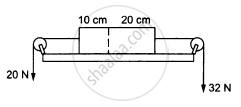
In the following figure shows a uniform rod of length 30 cm and mass 3.0 kg. The strings shown in the figure are pulled by constant forces of 20 N and 32 N. Find the force exerted by the 20 cm part of the rod on the 10 cm part. All the surfaces are smooth and the strings and the pulleys are light.
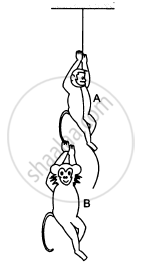
The monkey B, shown in the following figure, is holding on to the tail of monkey A that is climbing up a rope. The masses of monkeys A and B are 5 kg and 2 kg, respectively. If A can tolerate a tension of 30 N in its tail, what force should it apply on the rope in order to carry monkey B with it? Take g = 10 m/s2.
The linear momentum of a body of mass m moving with velocity v is :
A force acts for 10 s on a stationary body of mass 100 kg, after which the force ceases to act. The body moves through a distance of 100 m in the next 5 s. Calculate : The magnitude of the force
ame the law of motion which gives the definition of force.
What do you mean by linear momentum of a body?
A stone is dropped from a cliff 98 m high.
What will be its speed when it strikes the ground?
A stone is dropped from a tower 98 m high. With what speed should a second stone be thrown 1 s later so that both hit the ground at the same time?
In the previous problem (5.3), the magnitude of the momentum transferred during the hit is ______.
