Advertisements
Advertisements
प्रश्न
A woman throws an object of mass 500 g with a speed of 25 ms1.
- What is the impulse imparted to the object?
- If the object hits a wall and rebounds with half the original speed, what is the change in momentum of the object?
Advertisements
उत्तर
Mass of the object (m) = 500 g = 0.5 kg
Speed of the object (v) = 25 m/s
a. Impulse imparted to the object = Change in momentum
= mv – mu
= m(v – u)
= 0.5(25 – 0)
= 12.5 N-s
b. Velocity of the object after rebounds
= `- 25/2` m/s
v' = – 12.5 m/s
∴ Change in momentum = m(v’ – v)
= 0.5 (– 12.5 – 25)
= – 18.75 N-s
APPEARS IN
संबंधित प्रश्न
You are travelling in a car. The driver suddenly applies the brakes and you are pushed forward. Why does this happen?
An object is placed far away from all the objects that can exert force on it. A frame of reference is constructed by taking the origin and axes fixed in this object. Will the frame be necessarily inertial?
A car accelerates on a horizontal road due to the force exerted by.
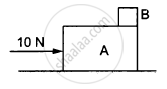
A small block B is placed on another block A of mass 5 kg and length 20 cm. Initially, the block B is near the right end of block A (In the following Figure). A constant horizontal force of 10 N is applied to the block A. All the surfaces are assumed frictionless. Find the time that elapses before block B separates from A.
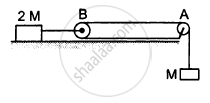
Consider the situation shown in the following figure. Both the pulleys and the string are light and all the surfaces are frictionless.
- Find the acceleration of the mass M.
- Find the tension in the string.
- Calculate the force exerted by the clamp on the pulley A in the figure.
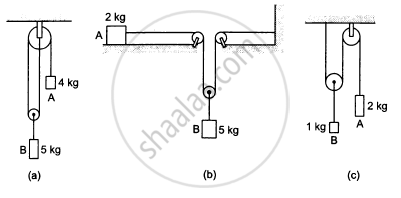
Find the acceleration of the blocks A and B in the three situations shown in the following figure.
A monkey of mass 15 kg is climbing a rope fixed to a ceiling. If it wishes to go up with an acceleration of 1 m/s2, how much force should it apply on the rope? If the rope is 5 m long and the monkey starts from rest, how much time will it take to reach the ceiling?
Show that the rate of change of momentum = mass × acceleration. Under what condition does this relation hold?
Two bodies A and B of same mass are moving with velocities v and 2v, respectively. Compare their (i) inertia and (ii) momentum.
State Newton's second law of motion. Under what condition does it take the form F = ma?
The correct form of Newton's second law is :
A force of 10 N acts on a body of mass 2 kg for 3 s, initially at rest. Calculate : The velocity acquired by the body
Calculate the velocity of a body of mass 0.5 kg, when it has a linear momentum of 5 Ns.
Multiple Choice Question. Select the correct option.
A force acts on a body of mass 3 kg such that its velocity changes from 4 ms−1 to 10 ms−1. The change in momentum of the body is
What do you mean by linear momentum of a body?
Why is it advantageous to turn before taking a long jump?
A stone is thrown vertically upward with a velocity of 9.8 m/s. When will it reach the ground?
A body of mass 2 kg travels according to the law x(t) = pt + qt2 + rt3 where p = 3 ms−1, q = 4 ms−2 and r = 5 ms−3. The force acting on the body at t = 2 seconds is ______.
According to Newton's Second Law of Motion, what quantity is directly proportional to the applied force?
What happens when a car brakes to come to a stop?
