Advertisements
Advertisements
प्रश्न
A force acts for 10 s on a stationary body of mass 100 kg, after which the force ceases to act. The body moves through a distance of 100 m in the next 5 s. Calculate : The magnitude of the force
Advertisements
उत्तर
Mass, m = 100 kg
Distance moved, s = 100 m
Initial velocity, u = 0
Force, F = ma
Or, F = (100) (2) N.
Or, F = 200 N.
APPEARS IN
संबंधित प्रश्न
A body of mass 0.40 kg moving initially with a constant speed of 10 m s–1 to the north is subject to a constant force of 8.0 N directed towards the south for 30 s. Take the instant the force is applied to be t = 0, the position of the body at that time to be x = 0, and predict its position at t = –5 s, 25 s, 100 s.
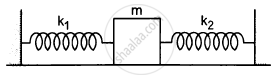
Both the springs shown in the following figure are unstretched. If the block is displaced by a distance x and released, what will be the initial acceleration?
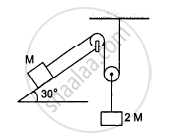
Find the acceleration of the block of mass M in the situation shown in the following figure. All the surfaces are frictionless and the pulleys and the string are light.
A tennis ball and a cricket ball , both are stationary. To start motion in them .
Write the mathematical form of Newton's second law of motion. State the conditions if any.
State Newton's second law of motion. Under what condition does it take the form F = ma?
State the magnitude and direction of the force of gravity acting on the body of mass 5 kg. Take g = 9.8 m s-2.
Multiple Choice Question. Select the correct option.
A force acts on a body of mass 3 kg such that its velocity changes from 4 ms−1 to 10 ms−1. The change in momentum of the body is
A ball is thrown vertically downward with an initial velocity of 10 m/s. What is its speed 1 s later and 2 s later?
A ball is thrown upward and reaches a maximum height of 19.6 m. Find its initial speed?
