Advertisements
Advertisements
प्रश्न
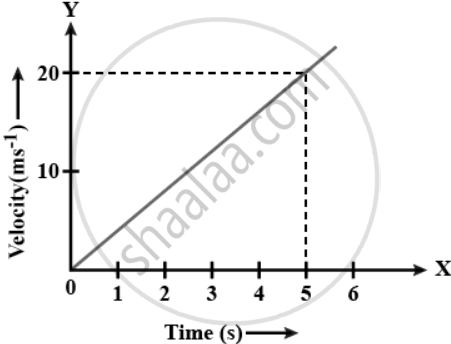
Figure shows the velocity-time graph of a particle of mass 100 g moving in a straight line. Calculate the force acting on the particle.
(Hint : Acceleration = Slope of the v-t graph)
Advertisements
उत्तर
Given mass, m = 100 g = 0.1 kg.
Slope of a velocity-time graph gives the value of acceleration.
Acceleration = Slope = `20/5` = 4 m/s2.
Force = Mass × Acceleration.
Force = 0.1 × 4 = 0.4 N.
APPEARS IN
संबंधित प्रश्न
A stone is released from the top of a tower of height 19.6 m. Calculate its final velocity just before touching the ground.
What is the acceleration produced in a freely falling body of mass 10 kg ? (Neglect air resistance)
What force is responsible for the earth revolving round the sun ?
What is the usual value of the acceleration due to gravity of earth ?
A pressure of 10 Pa acts on an area of 3.0 m2. What is the force acting on the area ? What force will be exerted by the application of same pressure if the area is made one-third ?
What would be the value of ‘g’ on the surface of the earth if its mass was twice and its radius half of what it is now?
Choose one or more correct alternatives.
Which of the forces involved in dragging a heavy object on a smooth, horizontal surface, have the same magnitude?
- The horizontal applied force
- gravitational force
- reaction force in vertical direction
- force of friction
The total energy of an object falling freely towards the ground ______.
What is escape velocity?
The mass and weight of an object on earth are 5 kg and 49 N respectively. What will be their values on the moon? Assume that the acceleration due to gravity on the moon is 1/6th of that on the earth.
