Advertisements
Advertisements
प्रश्न
A ball thrown up vertically returns to the thrower after 6 s. Find
- the velocity with which it was thrown up,
- the maximum height it reaches, and
- its position after 4 s.
Advertisements
उत्तर
a. Final velocity (v) = 0
Time (t) = 6s
g = 10m/s2
The first equation of motion
v = u + gt
0 = u + (−9.8) × 3 (negative sign due to opposite direction)
u = 30m/s
Hence, the ball is thrown upwards with a velocity of 30m/s.
b. Initial velocity (u) = 30m/s
Final velocity (v) = 0
Time (t) = 3s
the second equation of motion
h = ut + `1/2` gt2
h = `30 × 3 + 1/2 xx (−10) x (3)^2`
h = 90 − 45
h = 45m
Hence, the maximum height attained by the ball is 45m.
c. Position of the ball after 4 s Distance travelled downwards in 1 sec the second equation of motion
h = ut + `1/2` gt2
h = `0 xx 1 + 1/2 xx 10 xx (1)^2`
h = 5m
Distance covered in 1 second = 5m
Distance covered in 4 seconds = 45 − 5
= 40 m
Hence, after 4 seconds, the ball will be 40m above the ground.
संबंधित प्रश्न
State whether the following statement is true or false :
The acceleration due to gravity acting on a freely falling body is directly proportional to the mass of the body.
Fill in the following blank with suitable word :
The acceleration due to gravity on the moon is about ………………of that on the earth.
What do you mean by the term free fall ?
A ball falls off a table and reaches the ground in 1 s. Assuming g=10 m/s2, calculate its speed on reaching the ground and the height of the table.
A force of 15 N acts on a body of mass 2 kg. Calculate the acceleration produced.
A force of 10 N acts on a body of mass 5 kg. Find the acceleration produced.
A force acts for 10 s on a stationary body of mass 100 kg, after which the force ceases to act. The body moves through a distance of 100 m in the next 5 s. Calculate : The acceleration produced by the force
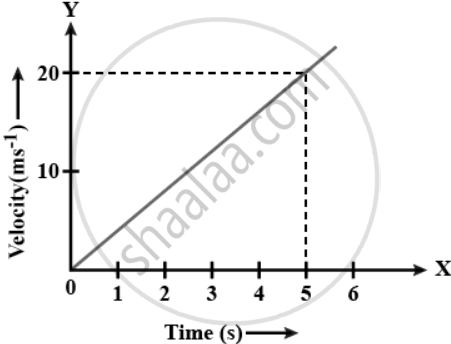
Figure shows the velocity-time graph of a particle of mass 100 g moving in a straight line. Calculate the force acting on the particle.
(Hint : Acceleration = Slope of the v-t graph)
Explain why:
Objects fall to the earth.
Right or wrong sentence:
The value of gravitational acceleration at the centre of earth is zero.
