Advertisements
Advertisements
प्रश्न
In what direction does the buoyant force on an object immersed in a liquid act?
Advertisements
उत्तर
An object immersed in a liquid experiences buoyant force in the upward direction.
संबंधित प्रश्न
What is the other name of buoyant force ?
Name the force which makes heavy objects appear light when immersed in a liquid.
Relative density of a substance is expressed in g cm-3.
The weight of a body is more than the buoyant force experienced by it, due to a liquid. The body will
The density of water is 1.0 g Cm-3. The density of iron is 7.8 × 10″3 g Cm-3. The density of mercury is 13.6 g Cm-3.
Ans the following:
Will a piece of iron float or sink in water?
Why does it happen?
A ship dips to a larger depth in fresh water as compared to marine water.
How does the pressure exerted by thrust depend on the area of surface on which it acts? Explain with a suitable example.
Write an expression for the pressure at a point inside a liquid. Explain the meaning of the symbols used.
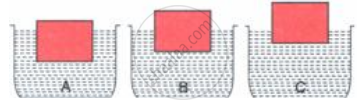
Figure shows the same block of wood floating in three different liquids A, B and C of densities ρ1, ρ2 and ρ3 respectively. Which of the liquid has the highest density? Give a reason for your answer.
What do you mean by buoyancy?
