Advertisements
Advertisements
प्रश्न
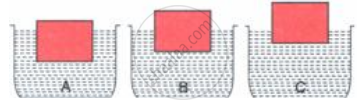
Figure shows the same block of wood floating in three different liquids A, B and C of densities ρ1, ρ2 and ρ3 respectively. Which of the liquid has the highest density? Give a reason for your answer.
Advertisements
उत्तर
The upthrust on the body by each liquid is the same and equal to the weight of the body.
However, upthrust = Volume submerged × ρL × g,
For the liquid C, since the volume submerged is least so the density ρ3 must be maximum.
संबंधित प्रश्न
A body X sinks in water, but a body Y floats on water. The density of the body X is ......... than the density of body Y.
Define buoyant force. Name two factors on which buoyant force depends.
Name the S.I. unit of density. How is it related to g Cm-3?
A plastic cube is released into the water. Will it sink or come to the surface of the water?
How does the pressure exerted by thrust depend on the area of surface on which it acts? Explain with a suitable example.
The area of base of a cylindrical vessel is 300 cm2. Water (density= 1000 kg m-3) is poured into it up to a depth of 6 cm. Calculate : (a) the pressure and (b) the thrust of water on the base. (g = 10m s-2.
A small block of wood is completely immersed in (i) water, (ii) glycerine and then released. In each case, What do you observe? Explain the difference in your observation in the two cases.
Complete the following sentence :
Two balls, one of iron and the other of aluminium experience the same upthrust when dipped completely in water if _____________ .
Two spheres A and B, each of volume 100 cm3 is placed on water (density = 1.0 g cm−3). The sphere A is made of wood of density 0.3 g cm−3 and sphere B is made of iron of density 8.9 g cm−3.
- Find:
- The weight of each sphere, and
- The upthrust on each sphere.
- Which sphere will float? Give reason.
