Advertisements
Advertisements
Question
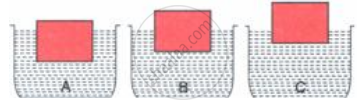
Figure shows the same block of wood floating in three different liquids A, B and C of densities ρ1, ρ2 and ρ3 respectively. Which of the liquid has the highest density? Give a reason for your answer.
Advertisements
Solution
The upthrust on the body by each liquid is the same and equal to the weight of the body.
However, upthrust = Volume submerged × ρL × g,
For the liquid C, since the volume submerged is least so the density ρ3 must be maximum.
RELATED QUESTIONS
What is meant by the term ‘buoyancy’ ?
Which of the following will sink or float on water? (Density of water = 1 g Cm-3)
body D having density 0.85 g m-3
What physical quantity is measured in bar?
Complete the following sentence :
Pressure is .................... in all directions about a point in a liquid.
Complete the following sentence :
Pressure at all points at the same depth is ....................
A block of iron of mass 7.5 kg and of dimensions 12 cm × 8 cm × 10 cm is kept on a table top on its base of side 12 cm × 8 cm.
Calculate:
- Thrust and
- Pressure exerted on the table top
Take 1 kgf = 10 N.
A body weighs 450 gf in air and 310 gf when completely immersed in water. Find
(i) The volume of the body,
(ii) The loss in weight of the body, and
(iii) The upthrust on the body.
State the assumption made in part (i).
Select the correct option.
Unit of thrust in the SI system is
Select the correct option:
When a body is wholly or partially immersed in a liquid, it experiences a buoyant force which is equal to:
Complete the analogy.
Downward force: Weight:: Upward force offered by liquid: _____
