Advertisements
Chapters
![Frank solutions for Physics [English] Class 9 ICSE chapter 4 - Fluids - Shaalaa.com](/images/physics-english-class-9-icse_6:1a0f7706074c4feda1fb5ca0ff12ac66.jpg "Frank solutions for Physics [English] Class 9 ICSE chapter 4 - Fluids")
Advertisements
Solutions for Chapter 4: Fluids
Below listed, you can find solutions for Chapter 4 of CISCE Frank for Physics [English] Class 9 ICSE.
Frank solutions for Physics [English] Class 9 ICSE 4 Fluids Exercise 1 [Pages 157 - 158]
Differentiate between thrust and pressure.
(i) Calculate the height of a water column which will exert on its base the same
Pressure as the 70 cm column of mercury.
(ii) Will the height of the water column change if the cross-section of the water column is made wider?
A dam has broader walls at the bottom than at the top. Explain.
State three factors on which the pressure at a point in a liquid depends.
What is meant by a fluid?
What is a fluid pressure?
State the laws of liquid pressure.
How does the liquid pressure on a diver change according to the following condition:
When the driver moves horizontally
How does the liquid pressure on a diver change according to the following condition:
When the driver moves to the greater depth?
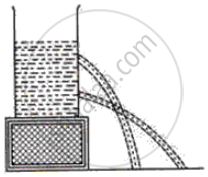
What fact about liquid pressure does the following diagram in the following figure illustrate?
The following figure shows a manometer containing a liquid of density p. The limb P of the manometer is connected to a vessel V and the limb Q is open to atmosphere. The difference in the levels of liquid in the two limbs of the manometer is h as shown in the diagram. The atmospheric pressure is P0.
(i) What is the pressure on the liquid surface in the limb Q?
(ii) What is the pressure on the liquid surface in the limb P?

State Pascal's law of transmission of pressure.
Name three applications of Pascal's law.
What is the use of altimeter?
Frank solutions for Physics [English] Class 9 ICSE 4 Fluids Exercise 2 [Pages 173 - 175]
A small stone of mass m ( = 200 g ) is held underwater in a tall jar and allowed to fall as shown in the following figure. The free-body diagram of the stone is also shown.
(i) What does F2 represent?
(ii) What does m1 represent?
(iii) What is the net force acting on the stone?
(iv) What is the acceleration of the stone as it falls through water? Neglect the force due to viscosity. Assume that volume of stone = 80 cml, density of water = 1.0 g cm-3 and acceleration due to gravity g = 10 ms-2.

A body weighs 300 gf in air and 280 gf when completely immersed in water. Calculate:
(i) The loss in weight of the body,
(ii) The upthrust on the body.
It is easier to lift a heavy stone under water than in air. Explain.
State Archimedes principle.
Describe an experiment to verify the Archimedes' principle.
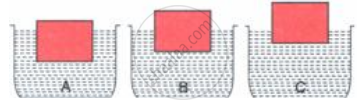
Figure shows the same block of wood floating in three different liquids A, B and C of densities ρ1, ρ2 and ρ3 respectively. Which of the liquid has the highest density? Give a reason for your answer.
Explain why an iron nail floats on mercury, but it sinks in water.
Hint : Density of iron is less than that of mercury, but more than that of water.
Write the SI units of Buoyant force
Write the SI units of Density
Write the SI units of Weight of a body
Write the SI units of Relative density
An iron nail sinks in the water while an iron ship floats on water. Explain the reason.
What can you say about the average density of a ship floating on water?
A piece of ice floating in a glass of water melts, but the level of water in the glass does not change.
Give reasons.
Hint: Ice contracts on melting.
A man first swims in sea water and then in river water. (i) Compare the weights of sea water and river water displaced by him.
(ii) Where does he find it easier to swim and why?
If 2/3rds of a piece of wood submerges in water and 3/4ths of the same piece of wood submerges in oil. Find the density of the oil.
A piece of wax floats in brine. What fraction of its volume will be immersed?
R.D. of wax = 0.95, R.D. of brine = 1.1.
If the density of ice is 0.9 g cm-3, then what portion of an iceberg will remain below the surface of water in sea? (Density of sea water = 1.1 g cm-3)
Write the density of water at 4°C in S.I. unit .
A wooden cube of side 10 cm has a mass of 700 g. It will float in the water with:
(a) Half of its volume inside the water
(b) 3 cm height above the water surface
(c) 7 cm height above the water surface
(d) Just inside the water surface.
A block of wood of mass 24 kg floats on water. The volume of wood is 0.032 m3. Find:
- the volume of block below the surface of water,
- the density of wood.
(Density of water = 1000 kg m−3)
A body of volume 100 cm3 weighs 1 kgf in air. Find:
- Its weight in water and
- Its relative density.
The relative density of mercury is 13.6. State its density in
(i) C.G.S. unit and
(ii) S.I. unit.
The density of iron is 7.8 x 10³ kg m-3. What is its relative density?
How are the (i) Mass, (ii) Volume and (iii) Density of a metallic piece affected, if at all, with an increase in temperature?
Complete the following result:
Mass = _______ × density
Complete the following result:
S.l. unit of density is _________
Complete the following result:
The density of water is ______ Kgm-3.
Complete the following result:
Density in kg m-3 = ______ x density in g cm-3
Frank solutions for Physics [English] Class 9 ICSE 4 Fluids Exercise 3 [Pages 177 - 178]
What do you mean by buoyancy?
What is meant by up thrust?
Is pressure a vector quantity?
Is thrust a scalar or vector quantity?
What is the SI unit of density?
What do you mean by relative density?
What are the factors on which the pressure of a liquid depends?
State Archimedes' principle. Does it apply to gases?
How is thrust different from pressure?
State Pascal's law.
Do all liquids exert pressure?
State two applications of Pascal's law.
What is the principle of a hydraulic machine?
State the principle on which Brahma press depends.
State two uses of a hydraulic press.
What is meant by atmospheric pressure?
What is the value of atmospheric pressure?
Name the instrument used to measure atmospheric pressure.
What is the use of altimeter?
What does a falling barometer indicate?
Define atmospheric pressure diving suits. Does a diving suit create buoyancy?
What do you mean by the term fluid pressure?
A dam has broader walls at the bottom than at the top. Explain.
State and explain Pascal's law of transmission of pressure.
State two factors which affect the atmospheric pressure as we go up.
How does the atmospheric pressure change with altitude?
What is the purpose of a barometer? State two major defects of a simple barometer.
Why do not we feel uneasy even under enormous pressure of the atmosphere above as?
How is the reading of a barometer affected when it is taken to: A mine
How is the reading of a barometer affected when it is taken to: A hill
A solid weighs 2.10 N in air. It has a relative density of 8.4. How much will the body weigh if placed: In water
A solid weighs 2.10 N in air. It has a relative density of 8.4. How much will the body weigh if placed: In a liquid of relative density 1.2
The density of iron is 7800 kg m-3. What do you mean by this statement? What is density of water at 40C?
Calculate the mass of a body whose volume is 2m3 and relative density is 0.52.
A piece of metal weighs 44.5 gf in air, 39.5 gf in water. What is the R.D. of the metal?
A body of volume 100 cm3 weighs 1 kgf in air. Calculate its weight in water. What is its relative density?
State the principle of floatation. What can you say about the average density of a ship floating on water?
For what purpose is the acid battery hydrometer used?
Explain why an iron nail floats on mercury, but it sinks in water.
Hint : Density of iron is less than that of mercury, but more than that of water.
State the principle of floatation.
Name an instrument based on this principle. State two uses of the instrument that you describe.
Explain the following :
A balloon filled with hydrogen rises to a certain height and then stops rising further.
Explain the following:
An egg sinks in fresh water but floats in a strong solution of salt.
Explain the following:
A hydrometer is made heavy near the bottom.
Explain the following:
Icebergs floating in the sea are very dangerous for ships.
What is a barometer?
How is a simple barometer constructed?
What is an aneroid barometer?
Draw a neat and labeled diagram to explain its construction and working.
Draw a simple diagram of a Fortin's barometer and state how it is used to measure the atmospheric pressure.
Describe an experiment to demonstrate that air exerts pressure.
Solutions for 4: Fluids
Frank solutions for Physics [English] Class 9 ICSE chapter 4 - Fluids
Shaalaa.com has the CISCE Mathematics Physics [English] Class 9 ICSE CISCE solutions in a manner that help students grasp basic concepts better and faster. The detailed, step-by-step solutions will help you understand the concepts better and clarify any confusion. Frank solutions for Mathematics Physics [English] Class 9 ICSE CISCE 4 (Fluids) include all questions with answers and detailed explanations. This will clear students' doubts about questions and improve their application skills while preparing for board exams.
Further, we at Shaalaa.com provide such solutions so students can prepare for written exams. Frank textbook solutions can be a core help for self-study and provide excellent self-help guidance for students.
Concepts covered in Physics [English] Class 9 ICSE chapter 4 Fluids are .
Using Frank Physics [English] Class 9 ICSE solutions Fluids exercise by students is an easy way to prepare for the exams, as they involve solutions arranged chapter-wise and also page-wise. The questions involved in Frank Solutions are essential questions that can be asked in the final exam. Maximum CISCE Physics [English] Class 9 ICSE students prefer Frank Textbook Solutions to score more in exams.
Get the free view of Chapter 4, Fluids Physics [English] Class 9 ICSE additional questions for Mathematics Physics [English] Class 9 ICSE CISCE, and you can use Shaalaa.com to keep it handy for your exam preparation.
