Advertisements
Advertisements
प्रश्न
State Pascal's law.
Advertisements
उत्तर १
Pascal's law states that pressure applied to an enclosed liquid, is transmitted equally to every part of the liquid or in other words when pressure is applied at a point in a confined fluid, it is transmitted undiminished and equally in all directions throughout the liquid.
उत्तर २
The pressure applied at any point of a liquid at rest, in a closed system, will be distributed equally through all regions of the liquid.
संबंधित प्रश्न
A piece of wood is floating in water kept in a bottle. The bottle is connected to an air pump. Neglect the compressibility of water. When more air is pushed into the bottle from the pump, the piece of wood will float with
Define one pascal (Pa), the S.I. unit of pressure.
Name two applications of Pascal's law.
Explain the working of a hydraulic brake with a simple labelled diagram.
The areas of pistons in a hydraulic machine are 5 cm2 and 625 cm2. What force on the smaller piston will support a load of 1250 N on the larger piston? State any assumption which you make in your calculation.
If the mechanical advantage of the handle of the pump plunger is 8, calculate the force applied at the end of the handle of the pump plunger.
Select the correct option.
One Pascal is equal to
Select the correct option.
Pressure applied in liquids is transmitted with undiminished force
The atmospheric pressure at a place is 650 mm of Hg. Calculate this pressure in Pascals (Pa).
How does the liquid pressure on a diver change according to the following condition:
When the driver moves to the greater depth?
Name three applications of Pascal's law.
The density of iron is 7800 kg m-3. What do you mean by this statement? What is density of water at 40C?
State Pascal’s law.
Assertion: Pascal’s law is the working principle of a hydraulic lift.
Reason: Pressure is thrust per unit area.
Analogy
Pascal’s law: ______:: Surface tensin: ______.
Match the following:
| 1. | Hydraulic press | a. | Archimedes |
| 2. | Cartesian Diver | b. | Floatation |
| 3. | Hydrostatic Balance | c. | Pascal’s law |
| 4. | Hydrometer | d. | Buoyancy |
A hydraulic press can lift 100 kg when a mass 'm' is placed on the smaller piston. It can lift ______ kg when the diameter of the larger piston is increased by 4 times and that of the smaller piston is decreased by 4 times keeping the same mass 'm' on the smaller piston.
Consider a water tank shown in the figure. It has one wall at x = L and can be taken to be very wide in the z direction. When filled with a liquid of surface tension S and density ρ, the liquid surface makes angle θ(θ << 1) with the x-axis at x = L. If y(x) is the height of the surface then the equation for y(x) is:
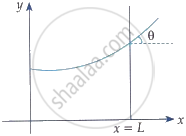
(take θ(x) = sin θ(x) = tan θ(x) = `dy/dx`, g is the acceleration due to gravity)
