Advertisements
Advertisements
प्रश्न
The following figure shows a manometer containing a liquid of density p. The limb P of the manometer is connected to a vessel V and the limb Q is open to atmosphere. The difference in the levels of liquid in the two limbs of the manometer is h as shown in the diagram. The atmospheric pressure is P0.
(i) What is the pressure on the liquid surface in the limb Q?
(ii) What is the pressure on the liquid surface in the limb P?

Advertisements
उत्तर
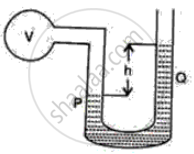
(i) The pressure on the liquid surface in the limb Q is equal to atmospheric pressure i.e P0.
(ii) According to the manometer principle, the difference in atmospheric pressure in two limbs is equal to the difference in height of liquid in two limbs.
So pressure at P = pressure at Q + h × p × g.
P0= PQ + h ×p × g.
APPEARS IN
संबंधित प्रश्न
State Pascal's law of transmission of pressure.
Select the correct option.
One Pascal is equal to
Select the correct option.
Pressure applied in liquids is transmitted with undiminished force
Define the SI unit of pressure.
Do all liquids exert pressure?
What is the principle of a hydraulic machine?
Hydraulic lift works under the principle of _______.
An iceberg of density 700 kg/m3 is floating in the water of density 1000 kg/m3. The percentage of the volume of ice cube outside the water is:
