Advertisements
Advertisements
Question
The following figure shows a manometer containing a liquid of density p. The limb P of the manometer is connected to a vessel V and the limb Q is open to atmosphere. The difference in the levels of liquid in the two limbs of the manometer is h as shown in the diagram. The atmospheric pressure is P0.
(i) What is the pressure on the liquid surface in the limb Q?
(ii) What is the pressure on the liquid surface in the limb P?

Advertisements
Solution
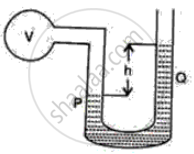
(i) The pressure on the liquid surface in the limb Q is equal to atmospheric pressure i.e P0.
(ii) According to the manometer principle, the difference in atmospheric pressure in two limbs is equal to the difference in height of liquid in two limbs.
So pressure at P = pressure at Q + h × p × g.
P0= PQ + h ×p × g.
APPEARS IN
RELATED QUESTIONS
Define one pascal (Pa), the S.I. unit of pressure.
Explain the principle of a hydraulic machine. Name two devices which work on this principle.
Explain the working of a hydraulic brake with a simple labelled diagram.
What should be the ratio of area of cross section of the master cylinder and wheel cylinder of a hydraulic brake so that a force of 15 N can be obtained at each of its brake shoe by exerting a force of 0.5 N on the pedal ?
Select the correct option.
Pressure applied in liquids is transmitted with undiminished force
Select the correct option.
The pressure exerted by 50 kg (g = 10 m/s−2) on an area of cross-section of 2 m2 is
How does the liquid pressure on a diver change according to the following condition:
When the driver moves to the greater depth?
Analogy
Pascal’s law: ______:: Surface tensin: ______.
