Advertisements
Advertisements
Question
How does the liquid pressure on a diver change according to the following condition:
When the driver moves to the greater depth?
Advertisements
Solution
When diver moves to depth, depth h increases, and thus pressure increases as diver moves to depth.
APPEARS IN
RELATED QUESTIONS
A piece of wood is floating in water kept in a bottle. The bottle is connected to an air pump. Neglect the compressibility of water. When more air is pushed into the bottle from the pump, the piece of wood will float with
What force is applied on a piston of area of cross section 2 cm2 to obtain a force 150 N on the piston of area of cross section 12 cm2 in a hydraulic machine?
66640 Pa pressure is exerted by 0.50 m vertical column of a liquid. If g = 9.8 Nkg−1, calculate the density of the liquid.
The area of cross-sections of the pump plunger and press plunger of a hydraulic press is 0.02 m2 and 8 m2 respectively. If the hydraulic press overcomes a load of 800 kgf, calculate the force acting on the pump plunger.
If the mechanical advantage of the handle of the pump plunger is 8, calculate the force applied at the end of the handle of the pump plunger.
Select the correct option.
A dam for water reservoir is built thicker at the bottom than at the top because
State Pascal's law.
State the principle on which Brahma press depends.
Hydraulic lift works under the principle of _______.
Consider a water tank shown in the figure. It has one wall at x = L and can be taken to be very wide in the z direction. When filled with a liquid of surface tension S and density ρ, the liquid surface makes angle θ(θ << 1) with the x-axis at x = L. If y(x) is the height of the surface then the equation for y(x) is:
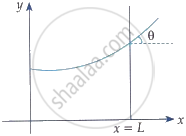
(take θ(x) = sin θ(x) = tan θ(x) = `dy/dx`, g is the acceleration due to gravity)
