Advertisements
Advertisements
Question
Advertisements
Solution
APPEARS IN
RELATED QUESTIONS
Consider the equations `P=lim_(triangles->0)"F"/(triangle"S")` and P1 - P2 = pgz. In an elevator accelerating upward
Name and state the principle on which a hydraulic press works. Write one use of hydraulic press.
Draw a simple diagram of a hydraulic jack and explain its working.
Select the correct option.
A dam for water reservoir is built thicker at the bottom than at the top because
Select the correct option.
The pressure exerted by 50 kg (g = 10 m/s−2) on an area of cross-section of 2 m2 is
P is the pressure at some point in a liquid. State whether pressure P is a scalar or vector quantity.
How does the liquid pressure on a diver change according to the following condition:
When the driver moves to the greater depth?
Name three applications of Pascal's law.
A hydraulic press can lift 100 kg when a mass 'm' is placed on the smaller piston. It can lift ______ kg when the diameter of the larger piston is increased by 4 times and that of the smaller piston is decreased by 4 times keeping the same mass 'm' on the smaller piston.
Consider a water tank shown in the figure. It has one wall at x = L and can be taken to be very wide in the z direction. When filled with a liquid of surface tension S and density ρ, the liquid surface makes angle θ(θ << 1) with the x-axis at x = L. If y(x) is the height of the surface then the equation for y(x) is:
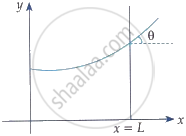
(take θ(x) = sin θ(x) = tan θ(x) = `dy/dx`, g is the acceleration due to gravity)
