Advertisements
Advertisements
प्रश्न
The following figure shows a manometer containing a liquid of density p. The limb P of the manometer is connected to a vessel V and the limb Q is open to atmosphere. The difference in the levels of liquid in the two limbs of the manometer is h as shown in the diagram. The atmospheric pressure is P0.
(i) What is the pressure on the liquid surface in the limb Q?
(ii) What is the pressure on the liquid surface in the limb P?

Advertisements
उत्तर
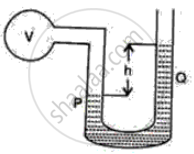
(i) The pressure on the liquid surface in the limb Q is equal to atmospheric pressure i.e P0.
(ii) According to the manometer principle, the difference in atmospheric pressure in two limbs is equal to the difference in height of liquid in two limbs.
So pressure at P = pressure at Q + h × p × g.
P0= PQ + h ×p × g.
APPEARS IN
संबंधित प्रश्न
State Pascal's law of transmission of pressure.
Explain the working of a hydraulic brake with a simple labelled diagram.
In a hydraulic machine, a force of 2 N is applied on the piston of area of cross section 10 cm2. What force is obtained on its piston of area of cross section 100 cm2 ?
The areas of pistons in a hydraulic machine are 5 cm2 and 625 cm2. What force on the smaller piston will support a load of 1250 N on the larger piston? State any assumption which you make in your calculation.
Select the correct option.
Pressure at a point inside a liquid does not depend on
The pressure in the water pipe on the ground floor of a building is 40000 pascals, whereas on the first floor it’s 10000 pascals. Find the height of the first floor. (Acceleration due to gravity g = 10 ms−2)
How does the liquid pressure on a diver change according to the following condition:
When the driver moves horizontally
Name three applications of Pascal's law.
What is the use of altimeter?
