Advertisements
Advertisements
Question
State two applications of Pascal's law.
Advertisements
Solution
- Hydraulic machines such as hydraulic press.
- hydraulic brakes and hydraulic jacks are applications of pascal's law.
APPEARS IN
RELATED QUESTIONS
Explain the principle of a hydraulic machine. Name two devices which work on this principle.
What should be the ratio of area of cross section of the master cylinder and wheel cylinder of a hydraulic brake so that a force of 15 N can be obtained at each of its brake shoe by exerting a force of 0.5 N on the pedal ?
A force of 50 kgf is applied to the smaller piston of a hydraulic machine. Neglecting friction, find the force exerted on the large piston, if the diameters of the pistons are 5 cm and 25 cm respectively.
66640 Pa pressure is exerted by 0.50 m vertical column of a liquid. If g = 9.8 Nkg−1, calculate the density of the liquid.
If the mechanical advantage of the handle of the pump plunger is 8, calculate the force applied at the end of the handle of the pump plunger.
The pressure in the water pipe on the ground floor of a building is 40000 pascals, whereas on the first floor it’s 10000 pascals. Find the height of the first floor. (Acceleration due to gravity g = 10 ms−2)
Define the SI unit of pressure.
The density of iron is 7800 kg m-3. What do you mean by this statement? What is density of water at 40C?
Unit of pressure is
Consider a water tank shown in the figure. It has one wall at x = L and can be taken to be very wide in the z direction. When filled with a liquid of surface tension S and density ρ, the liquid surface makes angle θ(θ << 1) with the x-axis at x = L. If y(x) is the height of the surface then the equation for y(x) is:
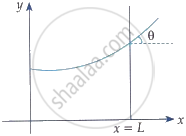
(take θ(x) = sin θ(x) = tan θ(x) = `dy/dx`, g is the acceleration due to gravity)
