Advertisements
Advertisements
Question
Advertisements
Solution
A manometer is a simple pressure gauge that measures differences in pressure at the two ends of the apparatus.
The manometer is a U shaped tube containing water whose one limb is dipped in vessel and vessel is tightly covered with a plastic sheet. U shaped tube has two limbs one towards the vessel and the other is opened to the atmosphere.
Now if the level of water toward atmospheric open limb is more than the level of water in limb towards apparatus end then the liquid is said to be at a higher pressure than the atmosphere. And if the level of water toward atmospheric open limb is less than the level of water in limb towards apparatus end then the liquid is said to be at a lower pressure than atmospheric pressure.
APPEARS IN
RELATED QUESTIONS
What vertical height of water will exert a pressure of 333200 Pa? The density of water is 1000 kgnr3 and g = 9.8 ms−2.
Calculate the equivalent height of mercury, which will exert as much pressure as 960 m of seawater of density 1040 kgm−3. The density of mercury is 13600 kgm−3.
The pressure of water on the ground floor is 160000 Pa. Calculate the pressure on the fifth floor, at a height of 15 m.
The normal pressure of air is 76 cm of mercury. Calculate the pressure in SI units.
[Density of mercury = 13600 kg/m3 and g = 10 m/s2]
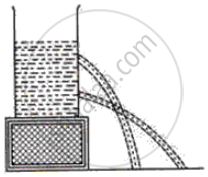
What fact about liquid pressure does the following diagram in the following figure illustrate?