Advertisements
Advertisements
Question
Advertisements
Solution
APPEARS IN
RELATED QUESTIONS
What vertical height of water will exert a pressure of 333200 Pa? The density of water is 1000 kgnr3 and g = 9.8 ms−2.
Calculate the equivalent height of mercury, which will exert as much pressure as 960 m of seawater of density 1040 kgm−3. The density of mercury is 13600 kgm−3.
The normal pressure of air is 76 cm of mercury. Calculate the pressure in SI units.
[Density of mercury = 13600 kg/m3 and g = 10 m/s2]
(i) Calculate the height of a water column which will exert on its base the same
Pressure as the 70 cm column of mercury.
(ii) Will the height of the water column change if the cross-section of the water column is made wider?
What fact about liquid pressure does the following diagram in the following figure illustrate?
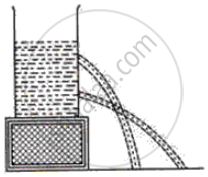
What is the SI unit of density?
What do you mean by relative density?
