Advertisements
Advertisements
Question
A dam has broader walls at the bottom than at the top. Explain.
Advertisements
Solution 1
The pressure exerted by a liquid increases with its depth. Thus as depth increases, more and more pressure is exerted by water on wall of the dam. A thicker wall is required to withstand greater pressure, therefore, the thickness of the wall of dam increases towards the bottom.
Solution 2
RELATED QUESTIONS
In what direction does the buoyant force on an object immersed in a liquid act?
What is meant by the term ‘buoyancy’ ?
A body X sinks in water, but a body Y floats on water. The density of the body X is ......... than the density of body Y.
If a fresh egg is put into a beaker filled with water, it sinks. On dissolving a lot of salt in the water, the egg begins to rise and then floats. Why ?
Define the term Density of a substance.
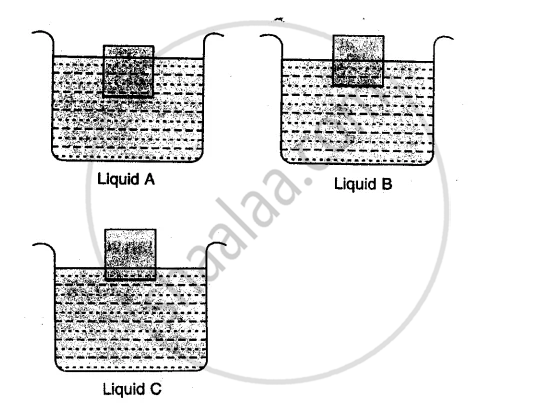
The diagram given below show a body floating in three different liquids. A, B and C at different levels.
(a) In which liquid does the body experience the greatest buoyant force?
(b) Which liquid has the least density?
(c) Which liquid has the highest density?
Define upthrust and state its S.I. unit.
It is easier to lift a heavy stone under water than in air. Explain.
Select the correct option:
When a body is wholly or partially immersed in a liquid, it experiences a buoyant force which is equal to:
How is thrust different from pressure?
