Advertisements
Advertisements
प्रश्न
Advertisements
उत्तर
We can find the relative density of a solid denser than water by following the experiment.
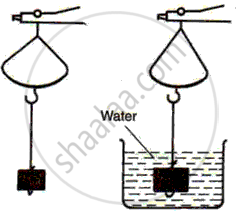
Weighing a solid in air and water
Find the weight (W1 gf) of a solid in the air using a hydrostatic balance.
Tie the solid firmly with a thread and suspend it from the hook. Lower the solid in water and find its weight.
Record the result as shown below:
Weight of solid in air = w1 gf.
Weight of solid in water = W2 gf.
The apparent loss of weight of solid = (W1 - W2 ) gf.
Relative density = W1/ (W1 - W2)
The relative density of the solid = (weight of solid in the air )/(Apparent loss of weight of solid in water).
APPEARS IN
संबंधित प्रश्न
When a piece of wood is suspended from the hook of a spring balance, it reads 70 gf. The wood is now lowered into water. What reading do you expect on the scale of spring balance?
A block of wood is so loaded that it just floats in water at room temperature. What change will occur in the state of floatation, if
(a) Some salt is added to water, (b) Water is heated?
Give reasons.
An iron nail sinks in the water while an iron ship floats on water. Explain the reason.
A piece of ice floating in a glass of water melts, but the level of water in the glass does not change.
Give reasons.
Hint: Ice contracts on melting.
Name an instrument based on this principle. State two uses of the instrument that you describe.
State the principle of floatation. What can you say about the average density of a ship floating on water?
Explain the following:
An egg sinks in fresh water but floats in a strong solution of salt.
Explain the following:
Icebergs floating in the sea are very dangerous for ships.
State the laws of flotation.
Hydrometer is based on the principle of ______.
