Advertisements
Advertisements
प्रश्न
Advertisements
उत्तर
We can find the relative density of a solid denser than water by following the experiment.
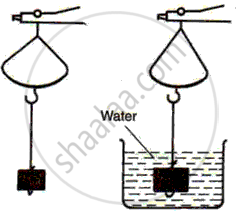
Weighing a solid in air and water
Find the weight (W1 gf) of a solid in the air using a hydrostatic balance.
Tie the solid firmly with a thread and suspend it from the hook. Lower the solid in water and find its weight.
Record the result as shown below:
Weight of solid in air = w1 gf.
Weight of solid in water = W2 gf.
The apparent loss of weight of solid = (W1 - W2 ) gf.
Relative density = W1/ (W1 - W2)
The relative density of the solid = (weight of solid in the air )/(Apparent loss of weight of solid in water).
APPEARS IN
संबंधित प्रश्न
Draw a diagram to show the forces acting on a body floating in water with its some part submerged. Name the forces and show their points of application. How is the weight of water displaced by the floating body related to the weight of the body itself?
Why is the floating ice less submerged in brine than in water?
A body floats in a liquid A of density ρ1 with a part of it submerged inside the liquid, while in liquid B of density ρ2 it is totally submerged inside the liquid. The densities ρ1 and ρ2 are related as :
Why does a ship make of iron not sink in water, while an iron nail sinks in it?
A block of wood of volume 25 cm3 floats in water with 20 cm3 of its volume immersed in water.
Calculate:
(1) density of wood
(2) the weight of block of wood.
Name an instrument based on this principle. State two uses of the instrument that you describe.
State the laws of flotation.
Where do we use lactometers?
Name different types of Hydrometers with their applications.
Describe the purpose, principle, and working of the Lactometer.
