Advertisements
Advertisements
Question
Advertisements
Solution
We can find the relative density of a solid denser than water by following the experiment.
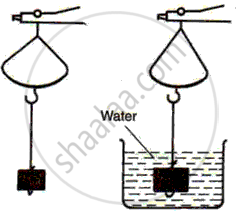
Weighing a solid in air and water
Find the weight (W1 gf) of a solid in the air using a hydrostatic balance.
Tie the solid firmly with a thread and suspend it from the hook. Lower the solid in water and find its weight.
Record the result as shown below:
Weight of solid in air = w1 gf.
Weight of solid in water = W2 gf.
The apparent loss of weight of solid = (W1 - W2 ) gf.
Relative density = W1/ (W1 - W2)
The relative density of the solid = (weight of solid in the air )/(Apparent loss of weight of solid in water).
APPEARS IN
RELATED QUESTIONS
A body is held immersed in a liquid. (i) Name the two forces acting on the body and draw a diagram to show these forces. (ii) State how the magnitudes of two forces mentioned in part (i) determine whether the body will float or sink in liquid when it is released. (iii) What is the net force on the body if it (a) sinks and (b) floats?
A solid iron ball of mass 500 g is dropped in mercury contained in a beaker. (a) Will the ball float or sink? Give reasons. (b) What will be the apparent weight of the ball?
A body floats in a liquid A of density ρ1 with a part of it submerged inside the liquid, while in liquid B of density ρ2 it is totally submerged inside the liquid. The densities ρ1 and ρ2 are related as :
Why does a ship make of iron not sink in water, while an iron nail sinks in it?
A test tube loaded with lead shots weighs 25 gf and floats upto the mark X in water. When the test tube is made to float in brine solution, it needs 5 gf more of lead shots to float upto level X. Find the relative density of brine solution.
A rubber ball floats in water with 2/7 of its volume above the surface of the water. Calculate the average relative density of the rubber ball.
Name an instrument based on this principle. State two uses of the instrument that you describe.
State the principle of floatation. What can you say about the average density of a ship floating on water?
Explain the following:
A hydrometer is made heavy near the bottom.
Where do we use lactometers?
