Advertisements
Chapters
![Frank solutions for Physics [English] Class 9 ICSE chapter 5 - Heat - Shaalaa.com](/images/physics-english-class-9-icse_6:1a0f7706074c4feda1fb5ca0ff12ac66.jpg "Frank solutions for Physics [English] Class 9 ICSE chapter 5 - Heat")
Advertisements
Solutions for Chapter 5: Heat
Below listed, you can find solutions for Chapter 5 of CISCE Frank for Physics [English] Class 9 ICSE.
Frank solutions for Physics [English] Class 9 ICSE 5 Heat Exercise [Page 191]
What do you mean by heat?
Is heat a form of energy?
Name the SI unit of heat.
Define one joule of heat.
What is the relation between joule and calorie?
Define temperature and write its SI unit.
Why does a piece of ice when touched with hands appear cold?
Distinguish between heat and temperature.
Two bodies at different temperatures are placed in contact with each other. State the direction in which heat flows.
Is it correct to say that heat is the cause of temperature?
What causes a change in the temperature of a body?
Which is more, a calorie or a joule?
1 joule = 4.2 calorie
Is this relation correct?
Two bodies are at same temperature. Do they necessarily contain same amount of heat?
Frank solutions for Physics [English] Class 9 ICSE 5 Heat Thermal Expansion [Pages 202 - 203]
Define coefficient of linear expansion.
Define the following term:
Coefficient of superficial expansion
Define the following term:
Coefficient of cubical expansion
What is a bimetallic strip?
What is the criterion of choosing the two metals for a bimetal strip?
Give two uses of a bimetal strip.
A bimetal strip is shown in the below diagram before heating. Draw a diagram to show how it bends on heating and on cooling.
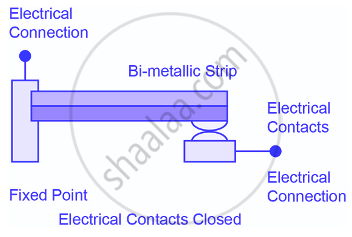
What is a thermostat
Give two uses of the thermostat.
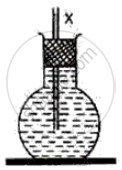
A round bottom flask containing coloured water, filtered with a stopper and a narrow glass tube is shown in the following diagram. What will happen to the water level X marked in the tube when it is placed in a hot water bath? Give a reason for your answer.
Give reasons for the following:
When boiling water is poured into a glass bottle, it generally cracks.
Give reasons for the following:
Telephone wires sag in summer.
Give reasons for the following:
In cold countries, water pipes burst in winter.
Give reasons for the following:
Even when the water in the lakes is frozen, fish can survive.
What will be the approximate temperature of water in the lake shown in the following diagram?
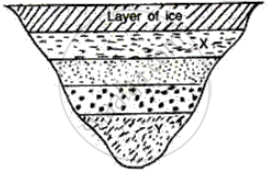
(i) At X, and
(ii) At Y?
The diagram shows a sketch graph showing a change in volume of a given mass of ice at -5°C to water at 15°C.
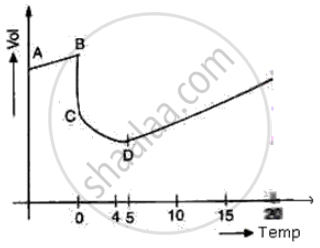
(i) Why does the temperature along BC remain constant?
(ii) When is the volume of water minimum?
(iii) At what temperature does water have maximum density? Explain.
Complete the following sentence:
The density of water is______. At 4°C.
Complete the following sentence:
When ice melts its volume ______ and density _______.
Complete the following sentence:
In a bimetal two metals of different _______ of _______ are used.
Complete the following sentence:
Water pipes burst in winter in very cold countries is due to ________
Complete the following sentence:
CGS units of heat is _________
Complete the following sentence:
SI unit of temperature is ______
The following figure shows a copper washer. Explain, giving reasons, whether the following characteristics of the washer increase, decrease, or remain the same when it is heated.
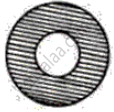
(a) Internal diameter
(b) Volume
(c) Mass
(d) Density
(e) External diameter
Frank solutions for Physics [English] Class 9 ICSE 5 Heat Thermometry [Pages 209 - 210]
What do you mean by temperature?
Frank solutions for Physics [English] Class 9 ICSE 5 Heat Transmission of Heat [Pages 226 - 227]
Define the process of conduction.
Is conduction possible in vacuum?
Out of metals, liquids, and gases:
Which one is the best conductor of heat?
Out of metals, liquids, and gases:
Which one is worst conductor of heat?
Why in cold countries windows have two glass panes with a thin layer
Of air between them?
Explain the following:
Water is heated generally from below.
Explain the following:
In a solid, heat is not transferred by the process of convection.
Explain the following:
Conduction is not possible in vacuum.
Explain the following:
Why is the cooling in a refrigerator kept near the top?
Explain the following:
It is cool in the shade, when it is hot outside.
The following figure shows a rectangular box with two tubes P and Q at the top. A burning candle R is placed under the tube P. The candle burns brightly.
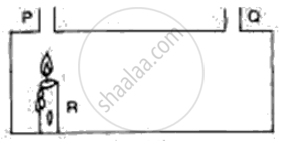
Explain:
(i) How is the air in the box circulating?
(ii) What will happen if the opening Q is closed?
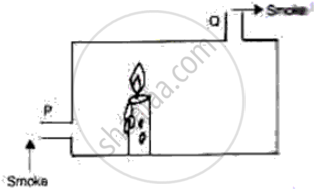
The following figure shows a container in which a lighted candle has been kept. The container has two openings, p, and Q. Which way the smoke from an external source placed near P moves when it reaches P and leaves from Q. Give a reason for your answer.
What is a greenhouse?
How does the air inside the greenhouse remain warm?
How will you minimize heat loss due to the following:
Convection
How will you minimize heat loss due to the following:
Conduction
How will you minimize heat loss due to the following:
Radiation
A red hot ball is suspended from the ceiling of a room using a thin metallic wire.
Name the ways in which the ball loses heat.
A red hot ball is suspended from the ceiling of a room using a thin metallic wire.
Suggest the way by which it loses the least amount of heat.
A red hot ball is suspended from the ceiling of a room using a thin metallic wire.
Explain what role does the air in the room play in the loss of heat.
Explain the term CFCs.
Explain the term UV.
Explain the term WHO.
Define global warming.
Frank solutions for Physics [English] Class 9 ICSE 5 Heat Exercise [Pages 229 - 232]
What do you mean by temperature?
What is the normal temperature of human body?
Convert 20°C into Fahrenheit scale.0
What is the upper fixed point on the Celsius scale?
Convert 80 K temperatures on the Celsius scale.
Write down the SI unit of latent heat.
Define coefficient of linear expansion. Write its SI unit.
Name the scientist who designed the first thermometer.
What is the principle of calorimetry?
Write the SI unit of coefficient of cubical expansion.
State two uses of a bimetallic strip.
Why do telephone wires sag during summer?
State the types of thermal expansion. What is the relation between α and γ?
Do all substances expand on heating? Give examples.
What is evaporation? Why does it cause cooling?
State three factors affecting evaporation.
What are land and sea breezes? Explain with the help of a labeled diagram.
Is conduction possible in gases?
Is conduction possible in vacuum?
What is the velocity of thermal radiations?
Why do we wear woolen clothes in winter?
Why is a newly made quit warmer than an old one?
In cold countries, the water pipes are covered with poor conductors. Why?
Name three devices which are used to detect heat radiations.
What is meant by thermal expansion?
What do you mean by linear expansion?
Define coefficient of linear expansion.
What is a bimetallic strip?
What is the unit of coefficient of linear expansion?
Name the substance which contracts when heated from 00C to 40C.
Define coefficient of volume expansion.
What is the unit of coefficient of volume expansion?
State two uses of a bimetallic strip.
How can a glass stopper jammed in the neck of a bottle be removed?
Why does a thick glass tumbler crack when very hot water is poured in it?
Why does a substance expand on heating?
What are the different types of thermal expansions?
A small gap is left between two iron rails of the railway track. Why?
Why are bridges made of steel girders put on rollers?
What is the relation between α and γ?
A copper wire 10 cm long is heated from 200C to 300C. Find the increase in length of the wire, if coefficient of linear expansion of copper is 1.7 X 10⁻⁵oC-1
One liter of mercury at 100C is heated to 300C. Find the increase in the volume of mercury. The coefficient of cubical expansion of mercury is 1.8 X 10⁻⁴ 0C-1.
Why is a ventilator provided in a room?
Is it possible to heat a liquid or gas from above? Explain your answer.
Explain the following:
Water is heated generally from below.
Explain the following:
Land becomes warmer than water during the day.
State three main characteristics of a thermometric substance.
Name a substance which is an insulator of heat.
Why in cold countries windows have two glass panes with a thin layer
Of air between them?
What is the relation between joule and calorie?
Is it possible to boil water in a thin paper container? Explain with a reason.
What is the principle of the thermometer?
State the advantages and disadvantages of mercury and alcohol as thermometric liquids.
What is meant by the lower and upper fixed points of a thermometer?
Draw a neat and labeled diagram of a clinical thermometer
State one use of each of the following type of thermometer:
Laboratory thermometer
State one use of each of the following type of thermometer:
Clinical thermometer
State one use of each of the following type of thermometer:
Six's maximum and minimum thermometer.
Distinguish between a clinical and a laboratory thermometer.
Convert the following temperature into Fahrenheit scale:
600C
Convert the following temperature into Fahrenheit scale:
1000C
Convert the following temperature into Fahrenheit scale:
-400C
Convert the following temperature into Fahrenheit scale:
850C.
Convert the following temperature into Celsius scale:
104oF
Convert the following temperature into Celsius scale:
95oF
Convert the following temperature into Celsius scale:
113oF
Convert the following temperature into Celsius scale:
32oF
Draw a neat and labeled diagram of a Six's maximum and minimum thermometer. Explain briefly, the working of this thermometer. Give a use of this thermometer.
Explain the three modes of transfer of heat.
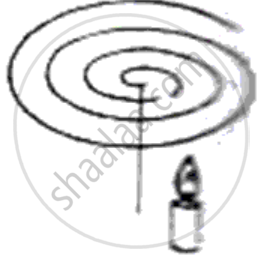
A spiral cut from a thick chart paper is pivoted at 0 and is held slightly above a burning candle You will notice that the spiral starts moving. Explain.
Give a scientific reason for the following:
In winter the human body covered with a blanket keeps warm.
Give a scientific reason for the following:
It is better to use thin blankets to keep the body warm rather than using a single blanket of thickness equal to their combined thickness.
Give a scientific reason for the following:
In winter the birds fluff up their feathers.
Give a scientific reason for the following:
Old quits are less warm than the new ones.
Give a scientific reason for the following:
On a hot sunny day, it is advisable to wear light coloured clothes.
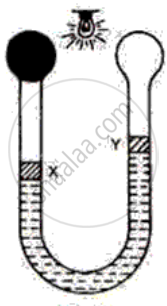
The diagram in the following shows two air filled bulbs connected by a U-tube containing mercury kept equidistant from a glassing bulb.
(i) Explain, how will the level X and Y change? (ii) Give a reason for your answer.
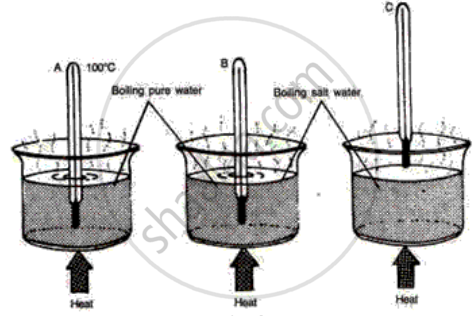
The following diagrams illustrate three situations involving thermometers which are labeled A, Band C. In each situation the thermometers indicate different readings.
(i) What do you expect the approximate reading of the thermometer B and C would be? Give a reason for your answer.
(ii) How would the readings of A and B help you in calibrating a thermometer?
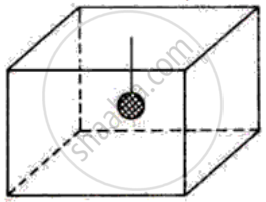
The hot metal ball is suspended from a string in a metal box as shown in the following figure
(i) What are the ways in which the ball loses heat
(ii) Which side of the box will be the hottest and which the least hot after some time? Explain.
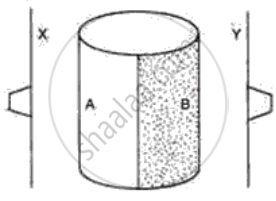
The following figure shows a metal cylinder, containing boiling water. One half side A is polished and another half, B is painted black. Two thin metal sheets X and Y are painted black and have one rubber stopper fixed with wax on each sheet. These sheets are equidistant from the boiling water (container A, B) as shown in the diagram. What would you expect to happen after a few minutes? Give a reason for your answer.
Explain the following:
Why a thick glass tumbler is likely to crack when hot water is poured in it?
Explain the following:
Why does not a Pyrex tumbler crack when hot water is poured in it?
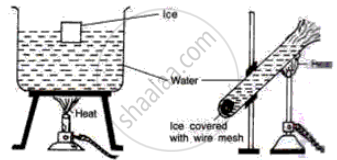
Study the following diagrams and write down your observations.
Solutions for 5: Heat
Frank solutions for Physics [English] Class 9 ICSE chapter 5 - Heat
Shaalaa.com has the CISCE Mathematics Physics [English] Class 9 ICSE CISCE solutions in a manner that help students grasp basic concepts better and faster. The detailed, step-by-step solutions will help you understand the concepts better and clarify any confusion. Frank solutions for Mathematics Physics [English] Class 9 ICSE CISCE 5 (Heat) include all questions with answers and detailed explanations. This will clear students' doubts about questions and improve their application skills while preparing for board exams.
Further, we at Shaalaa.com provide such solutions so students can prepare for written exams. Frank textbook solutions can be a core help for self-study and provide excellent self-help guidance for students.
Concepts covered in Physics [English] Class 9 ICSE chapter 5 Heat are Expansion of Solids, Consequences of Anomalous Expansion of Water, Application of Laws of Thermodynamics in Energy Flow, Energy Resources > Conventional energy resources or non-renewable energy resources, Electricity Generation using Solar Energy, Solar Energy Devices, Electricity Generation using Hydroelectric Energy, Bio-energy, Anomalous Expansion of Water, Electricity Generation using Wind Energy, Energy from the Sea, Sources of Energy, Heat, The Temperature and a Thermometer, Forms of Energy > Geo Thermal Energy, Thermal Expansion, Power Plants Based on Nuclear Energy, Conservation of Coal, Petroleum, and Natural Resources, Energy Degradation, Protecting our environment, Green House Effect, Preventive Measures of Green House Effect, Preventive Measures of Global Warming, Future Predictions of Global Warming, Expansion of Liquids, Expansion of Gases.
Using Frank Physics [English] Class 9 ICSE solutions Heat exercise by students is an easy way to prepare for the exams, as they involve solutions arranged chapter-wise and also page-wise. The questions involved in Frank Solutions are essential questions that can be asked in the final exam. Maximum CISCE Physics [English] Class 9 ICSE students prefer Frank Textbook Solutions to score more in exams.
Get the free view of Chapter 5, Heat Physics [English] Class 9 ICSE additional questions for Mathematics Physics [English] Class 9 ICSE CISCE, and you can use Shaalaa.com to keep it handy for your exam preparation.
