Advertisements
Advertisements
प्रश्न
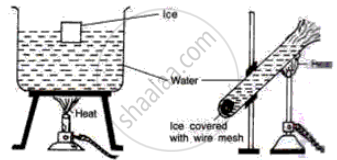
Study the following diagrams and write down your observations.
Advertisements
उत्तर

In the diagram, it is clear that the ice will melt faster in the flask than in the test tube because water is a bad conductor of heat and the transfer of heat in liquid through convection is from bottom to top.
APPEARS IN
संबंधित प्रश्न
Give reasons:
Water pipes burst in severe winters.
Draw a graph to show the variation in density of water with temperature in the range from 0°C to 10°C.
What do you understand by the anomalous expansion of water?
How do fishes survive in frozen lakes?
In cold countries, the water pipes are covered with poor conductors. Why?
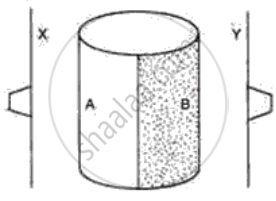
The following figure shows a metal cylinder, containing boiling water. One half side A is polished and another half, B is painted black. Two thin metal sheets X and Y are painted black and have one rubber stopper fixed with wax on each sheet. These sheets are equidistant from the boiling water (container A, B) as shown in the diagram. What would you expect to happen after a few minutes? Give a reason for your answer.
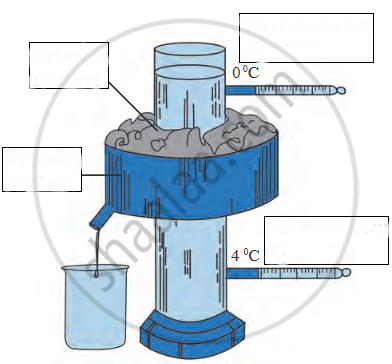
Draw a neat and labelled diagram of Hope’s apparatus.
Name the following diagram appropriately.
A graph between the volume and temperature of water is shown. Explain the anomalous behaviour of water.

